

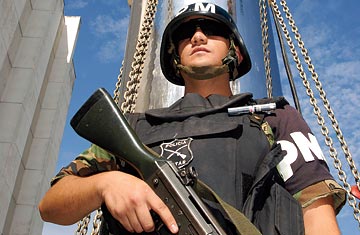
A Chilean police officer guards a cask containing Hightly Enriched uranium at the La Reina nuclear reactor in Santiago, Chile.
(4 of 4)
When the convoy carrying the HEU arrived at Valparaíso, two NNSA ships were anchored a short distance from the coast; the agency had decided to split up the material so that neither ship would carry enough HEU for an atom bomb. But as long as the HEU remained on land, it was vulnerable. About a dozen dockworkers moved freely among the containers. Two of the three bottles of Champagne Bieniawski had taken along for postshipment celebrations were stolen. By 9:45 a.m., the final shipping container was ready to load onto the first ship. As it hoisted the container into the air, one of the cranes malfunctioned, sending the container hurtling out of control, yards above the deck. For a few heart-stopping seconds, it swung back and forth. The cranes groaned. "I don't like that sight," Bieniawski said. "Jesus, I don't like that sight."
In all contracts with foreign governments, the NNSA gains title of the HEU at the exact moment that the crane's cables slacken and the container settles onto the ship. The crane operators regained control of the container, and a few moments later Chile no longer possessed a bomb's worth of HEU. In the bright morning sunshine, the first ship sailed out of the harbor, a Chilean gunboat darting in front of it like a little duckling. Onshore, the group piled back into the embassy van, and soon the remaining bottle of Champagne was uncorked. As Bieniawski slapped backs and offered high fives, his deputy remained quiet. Chuck Messick, a Navy man, has worked on the HEU-retrieval program since its inception in 1996. The HEU, he reminded anyone who would listen, still had to find safe passage through the Panama Canal and be safely unloaded in the U.S. "The mission," he said, "is not over yet. The mission is not over."