

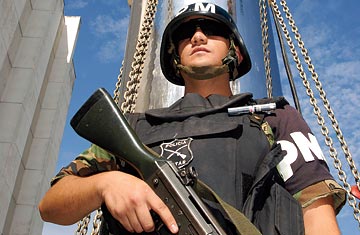
A Chilean police officer guards a cask containing Hightly Enriched uranium at the La Reina nuclear reactor in Santiago, Chile.
(2 of 4)
For the past 14 years, U.S. teams like the one in Chile have been engaged in a race against terrorists to gain control of the global supply of HEU--the compound from which a nuclear bomb can be most easily fabricated. President Barack Obama has said preventing terrorists from obtaining an atomic weapon is his Administration's top national-security priority, and last year he vowed that the U.S. would secure all vulnerable nuclear material within four years. On April 12, in one of the year's most important international meetings, Obama will host more than 40 heads of state for a nuclear-security summit in Washington, where he will rally support for that goal. A main thrust will be promoting the U.S. program to make HEU safe forever by sending it to U.S. or Russian facilities where it can be engineered into a form of uranium that cannot be used in bombs.
The fact that one of the most dangerous materials known to man came to find itself in Chile is the result of one of the great gambits of the 20th century. In the mid-1950s, as the international community became seriously concerned about nuclear proliferation, states that had nuclear weapons offered the world a bargain: they would give countries HEU in exchange for an inspection regime that could verify it would be used only for peaceful research and not weapons. Atoms for Peace, as the U.S. called the program, became the founding principle of the International Atomic Energy Agency (IAEA) and, later, the Nuclear Nonproliferation Treaty of 1968. Chile received HEU from the U.S., France and Britain in the 1970s and '80s.
All told, over several decades, the five permanent members of the U.N. Security Council distributed some 44,000 lbs. (20,000 kg) of HEU--enough for 800 nuclear weapons--to around 50 countries as diverse as Australia, Jamaica and Vietnam. Although that figure is a drop in the bucket compared with the estimated 4.4 million lbs. (2 million kg) of HEU in weapons and storage in the U.S. and Russia, the Atoms for Peace HEU is of particular concern because it is used in civilian reactors that are often poorly guarded and vulnerable to theft. As William Potter, director of the James Martin Center for Nonproliferation Studies at California's Monterey Institute of International Studies, points out, "If you are a terrorist, you don't necessarily go where there is the most material. You go where the material is most accessible."
It is Bieniawski's job to convince countries to give up their HEU and send it to either the U.S. or Russia. So far, the NNSA has removed a total of 5,935 lbs. (2,692 kg) of fissile material from 37 countries and has its sights on 4,190 lbs. (1,900 kg) more. To meet that goal, Obama has asked for the program's budget to be increased by 67% percent to $560 million next year. But many countries see HEU-fueled research reactors as symbols of prestige and don't necessarily share U.S. and Russian concern that fissile material may fall into terrorist hands. Canada and South Africa, which both have large stockpiles of HEU, argue they need it to make medical isotopes profitably. Politics comes into play too: poor relations between Ukraine and Russia have hampered efforts to move Ukraine's large stocks of HEU to Russian facilities.