

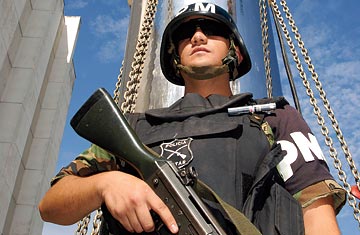
A Chilean police officer guards a cask containing Hightly Enriched uranium at the La Reina nuclear reactor in Santiago, Chile.
(3 of 4)
Bieniawski says his mission is to help overcome these obstacles by "schmoozing for my country," at which he is pretty good. (Once, he sweet-talked leaders from an African nation with HEU stocks by calling on their shared African heritage; although raised and educated in America, he was born to white parents in South Africa.) When he is unable to convince or pay countries to give up their HEU, Bieniawski offers to upgrade security around their material. That mission gained urgency in November 2007, when two teams of armed attackers stormed Pelindaba, a supposedly secure facility that houses hundreds of kilograms of weapons-grade uranium in South Africa. The attackers gained access to the facility's control room and shot an emergency-services officer in the chest. They fled without making any effort to steal the nuclear material, and the reason for the break-in and the attackers' identity remain a mystery. "The break-in validated what we do. Current international security guidelines are woefully inadequate," Bieniawski says, adding that no amount of physical protection can provide total security or combat the "insider threat." All confirmed cases of illicit trafficking of HEU in the past 20 years have involved employees siphoning off material and attempting to sell it on the black market--such as the 1992 arrest of a Russian engineer caught trying to sell 3.3 lbs. (1.5 kg) of HEU at the Podolsk train station. All the cases involved minimal amounts of HEU.
The Threat Is Real
HEU is of particular concern because of the relative ease with which it can be turned into a mushroom cloud. The uranium bomb exploded over Hiroshima was never tested, so simple was its mechanism. Peter Zimmerman, former chief scientist of the Senate Foreign Relations Committee, says a group of terrorists in possession of HEU could build an atom bomb using readily available hardware at a cost of around $2 million; if detonated in a city, such a bomb could kill hundreds of thousands. In Chile, I asked Bieniawski if he felt confident that al-Qaeda was still pursuing nuclear weapons rather than concentrating on struggles in Afghanistan and Pakistan. "The worst day of my week is Friday," he said. "Every Friday I receive a one-hour intelligence briefing, and I come away sobered. I assure you, the threat is real."
Graham Allison of Harvard University, a former Assistant Secretary of Defense who recently served on the Congressional Commission on the Prevention of WMD Terrorism, believes "it is more likely than not" that a terrorist will detonate a nuclear bomb in a U.S. city by 2014. Other experts, such as John Mueller of Ohio State University in Columbus, contend that such an estimate is greatly exaggerated. But Mueller, too, supports an HEU-elimination program. "There's no point having the stuff hanging around for no reason," he says.
Could the Chilean HEU have fallen into terrorist hands? The afternoon before the earthquake, Paul Simons, the U.S. ambassador to Chile, pointed out that local criminal gangs ship Bolivian cocaine to the U.S. from Chilean ports and that "we recognize that Chile and its ports could be used as a funnel for other illicit materials." At the time, of course, he could not know that four days later a bomb's worth of HEU would be on its way to one of those ports--and in the middle of a national catastrophe.