

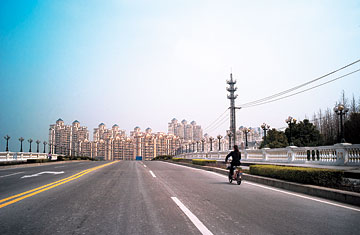
Onward and upward
A new town, Songjiang, rises on the outskirts of Shanghai
(4 of 4)
Six decades later, China has fully embraced globalization at home and has burst onto the world's stage in a largely positive fashion. It now has both interests and a presence in parts of the world completely new to China — such as Latin America and the Middle East — and enjoys rising international prestige. Beijing has generally managed its relations well with the major world powers: the U.S., Russia and the E.U. It has transformed its regional diplomacy in Asia, reasserted a role in Africa and become much more deeply engaged with international organizations and across a range of global-governance issues. China used to eschew multilateralism, distrusting it as some kind of (Western) conspiracy. While Beijing remains a selective multilateralist globally — engaging on some issues and not others — the broad trend has been positive and in the direction of deeper contributions to the world community.
China is also more proactive on global security issues ("hot spots" as Chinese analysts like to describe them). When natural disasters now strike, such as the South and Southeast Asian tsunami in 2004 and the Pakistan earthquake the following year, China is there to provide physical and financial assistance. China now has over 2,100 peacekeeping personnel deployed in about a dozen nations worldwide — more than any other member of the U.N. Security Council. This is one tangible expression of China's strong commitment to the U.N. Today, indeed, the PRC may be the greatest advocate of the U.N. among the major powers.
In the field of arms control, China used to be a serious proliferator of missiles and missile components, and a significant seller of conventional arms. But, over time, China has signed or ratified the Nuclear Non-Proliferation Treaty, the Comprehensive Test Ban Treaty and the Biological and Conventional Weapons Convention, has joined the Nuclear Suppliers Group and has essentially adhered to the Missile Technology Control Regime (although it is not a member). This is not the China that the world used to know: a "revisionist" destabilizing power that sought to overturn the international order. Today, the People's Republic of China is deeply involved across the globe and is increasingly an upholder of, and contributor to, the existing international order. China has been a considerable beneficiary of the post – Cold War order, which has allowed Beijing to establish a presence in regions and international institutions that was not previously possible.
China's strategic posture is also changing. Its military modernization program has made giant strides in recent years — and they will be on display in the massive military parade in central Beijing on Oct. 1. In many categories China's military is the best in Asia and in some sectors is approaching NATO standards. The People's Liberation Army still has no global strike capacity, however, other than its intercontinental ballistic missiles and cyberwarfare capabilities.
Still, many countries worry about China's rise and global expansion, even though it has, to date, been outwardly peaceful. Public opinion polls in Europe and the U.S. regularly reflect a negative image of China, while concerns over economic competition and job losses are growing in Europe, Africa and Latin America. Substantial strains remain in Beijing's ties with three of China's most important neighbors: Australia, India and Japan. Even relations with Russia, which have achieved historic highs since the collapse of the Soviet Union, have run into obstacles. This is unsurprising. As Beijing expands its influence and begins to flex its new muscle on the world stage, it's to be expected that China will engender occasional discord with other nations.
Future Shock?
Some historians of China think they see the telltale signs of dynastic decline: government corruption, social discontent (especially in the countryside), autocratic rulers and a militarizing state. Some contemporary China experts also voice their doubts — proclaiming the regime fragile and the political system ossified — while economists question how long the dynamic growth can continue.
While the system and country have weaknesses and challenges, the Sinological landscape is littered with its naysayers and critics. The People's Republic of China has endured for six decades and has overcome a wide variety of serious domestic crises, border wars and international isolation. Its strengths and adaptability have repeatedly been underestimated by outside observers. One thing is certain: China will remain a country of complexity and contradictions — which will keep China watchers and Chinese alike guessing about its future indefinitely.
Shambaugh is professor and director of the China Policy Program at George Washington University in Washington, D.C., nonresident senior fellow at the Brookings Institution, and currently a visiting scholar at the China Academy of Social Sciences in Beijing. His latest book is China's Communist Party: Atrophy and Adaptation