

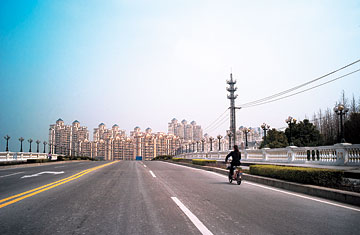
Onward and upward
A new town, Songjiang, rises on the outskirts of Shanghai
(2 of 4)
The Cost of Wealth
The question for China's leaders was never whether to modernize — but how. During the Maoist era a variety of economic models were experimented with, each of which achieving some modicum of growth. Yet all of them left China lagging far behind the West and East Asia. The costs of some initiatives, like the Great Leap Forward from 1958 to 1960, were catastrophic in human and environmental terms. It was not until Deng and Chen Yun, another reform-minded Politburo member, returned to power in 1978 from internal exile that the economic course was changed.
Three decades later, the world witnesses the extraordinary results. China is now the world's third largest economy, after the U.S. and Japan, and recently surpassed Germany as the largest exporting nation. Its GNP is on course to overtake Japan's by 2010 and perhaps that of the U.S. by 2020.
Much of this dynamic growth has been export-driven, benefiting the low- and medium-technology sectors of the economy. But China is beginning to move up the technological ladder and is becoming more innovative in certain sectors such as electronics and biotechnology. The country has become a manufacturing superpower and the workshop of the world, producing two-thirds of all photocopiers, microwaves and shoes; 60% of cell phones; 55% of DVDs; over half of all digital cameras; 30% of personal computers; and 75% of children's toys, plus a wide variety of other goods.
As a result of its economic boom, China has amassed a staggering $2 trillion in foreign exchange — the largest reserves in the world — and is beginning to invest significant amounts abroad. Today, 37 Chinese multinational corporations rank among FORTUNE's top 500 global companies, up from just six a decade ago, while 450 out of the FORTUNE 500 American companies have production lines and a business presence in China. China has become the world's largest recipient of foreign direct investment. To fuel its economic boom, China's voracious and insatiable appetite for raw materials has led it to absorb large amounts of global commodities. China now consumes 16% of global energy resources and is the world's third largest consumer of oil.
But the economic explosion has come at a high environmental cost. China's air and water are among the most polluted on earth and it is the leading emitter of greenhouse gases. The environmental nightmare is hurting public health. Malignant cancer now accounts for 28.5% of deaths while respiratory diseases account for 13.1%, according to the 2008 China Statistical Yearbook. China's growth has been dynamic, but it is also double-edged.
Reinventing a Nation
Mao spent his lifetime trying to transform Chinese society in his utopian, socialist and revolutionary vision. He tried to create a "new socialist man" and an equitable society. His regime succeeded in providing the world's largest population with food to eat, housing and basic services. Social vices were eliminated, literacy was expanded, life expectancy increased and infant mortality decreased. These were no small achievements. But Mao's efforts to impose socialism had a deadening effect on urban and rural society alike, as political movements repeatedly harassed different groups of people.
By the time Deng and his compatriots came to power in 1978, China was traumatized, tired and alienated by 30 years of Maoist experiments and totalitarian controls. Deng's wisdom was to recognize that the state needed to retreat from society and the economy if the creative and entrepreneurial spirits of ordinary Chinese were to be unleashed.
Three decades later, Chinese society has fully blossomed. Chinese today experience a wide variety of personal freedoms in daily life that they and their ancestors had never known. Chinese state and society have also reconnected with the past, emphasizing Confucian and Buddhist values. More than 200 million people have been lifted out of poverty and the members of a growing middle class with disposable income travel abroad, invest in the stock market, dine out and decorate their stylish apartments with furniture purchased from stores like Ikea. Access to education has become far more widespread. Some 21 million students attend university today, while an estimated 300,000 study abroad every year. Approximately 206 million Chinese children attend primary and secondary schools. Basic literacy is almost universal in China today, while it was roughly 20% in 1949. Still, China remains a poor country by global standards: some 207 million people still live below World Bank poverty levels on less than $1.25 per day.