

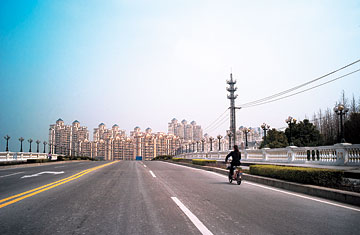
Onward and upward
A new town, Songjiang, rises on the outskirts of Shanghai
(3 of 4)
With economic growth have come demographic shifts and life improvements. Live expectancy has shot up while infant mortality has plummeted. In 1949 more than 90% of the population lived in rural areas; given the expansion of urban areas, slightly more than half (721 million) do today, according to official statistics. But China's increasing urbanization and spreading industrialization have resulted in a considerable loss of arable land and forcible evictions, sparking much resentment against local officials.
Chinese intellectual life has also improved, although over time this remains one of the real dark spots of Chinese communist rule. For six decades intellectuals have been persecuted, harassed and forced to conform and create within various boundaries set by the state. They continually probe the boundaries — until the state pushes back. Despite continuing controls, public and private discourse in China has never been so free. The blogosphere and Internet are alive with unbridled discussion — unless and until it crosses the state censor's invisible hand.
While China has made much progress, it still has many blemishes. Treatment of ethnic minorities — particularly Tibetans and Uighurs — is the Achilles' heel of the regime, as violent riots last year and in recent months have clearly demonstrated. Crime and corruption remain serious problems, while cities struggle to provide basic services to the huge "floating population" of 100 million or so migrants. Income disparities (as measured by the Gini coefficient) are now approaching the highest in the world. China has again become a stratified society — just what Mao sought to eliminate. Still, given the unprecedented scale and nature of China's socioeconomic change over the past 30 years, the country's relative stability is commendable.
Politics Not as Usual
At first glance, China's political system has not changed much since 1949. It is still a Leninist system, dominated by the CCP and an oligarchy of its self-selected leaders, which tolerates no opposition. The Party's powerful Organization Department oversees all major appointments in the country, and one must really be a party member to get ahead professionally. Party and government organs remain essentially as they were six decades ago, copied from the Soviet Union.
But while much of the structure and essential nature of the system remains largely the same, the substance and process of politics has changed quite a lot. The leadership and the 76 million party members are better educated and their recruitment and promotion is much more meritocratic. Competence is now rewarded. In the past, there existed only two exit paths from officialdom: purges and death. Now mandatory retirement is firmly implemented. Instead of being a totalitarian party dominated by a single leader, the CCP today is an authoritarian party with a collective leadership. The leaders themselves — at least those I have witnessed — are now remarkably self-assured and relatively sophisticated. Marxist-Leninist ideology plays little, if any, role in their decision-making. The policy process is more consultative, although still lacking in transparency. Much emphasis is put on governance and officials at all levels undergo required training in public administration.
On the whole, the Communist Party has proven itself to be remarkably adaptable and open to borrowing elements from different countries and political systems. As a result it is becoming a hybrid party with elements of East Asian neo-authoritarianism, Latin American corporatism and European social democracy all grafted to Confucianist-Leninist roots. The uprising in Tiananmen and across China in 1989 and the subsequent collapse of communist systems in Europe and the Soviet Union were instructive experiences for the CCP. Many lessons were drawn, but the principal one was to remain flexible and adaptable, not dogmatic and rigid.
Will the Party's adaptability and the nation's continuing economic growth be sufficient to sustain it in power indefinitely? Perhaps. The CCP's sustenance to date has certainly surprised many leading China watchers. But, going forward, the major challenge to the Party will likely be its ability to deliver adequate "public goods" to the population: health care, education, environmental protection and other social services. Providing stability and ever increasing personal wealth will not be enough to guarantee the Party indefinite legitimacy — it must continuously improve the quality of life of its citizens. This is China's new revolution: the revolution of rising expectations.
Taking On the World
Any consideration of China's transformation since 1949 must recognize the dramatic improvement in China's global posture. Sixty years ago the new People's Republic was cut off from the world, having diplomatic recognition only from a relatively small number of nations. It was excluded from the U.N. It soon became embroiled in the Korean War and the Cold War, which brought further isolation. Despite some marginal trade with Western Europe following the 1954 Geneva Conference on Indochina, China was cut off from international trade, finance and aid. As a result, its economy stagnated.