

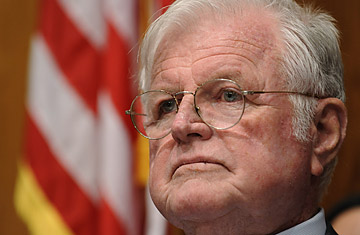
Senator Edward Kennedy
A Dream That Never Died BY BOB SHRUM
Last summer, as I flew toward Denver for the Democratic Convention on a small jet with Ted Kennedy, his family and a few friends, I thought of another convention 28 years before. It was the one Kennedy addressed in New York City after losing the Democratic nomination for President to Jimmy Carter. The speech Kennedy hoped to deliver in Denver would echo the earlier one, although a slight change in the closing words would make for a profound shift in mood. The robust Kennedy of 1980, announcing "The dream shall never die," was a young lion in winter, defiant in his beliefs even in defeat. The ailing Kennedy of 2008, stricken with incurable cancer but sailing every afternoon, told me that he was determined to conclude with an affirmation of hope. The convention and the country would not hear the word die from him. Instead, in that distinctive and commanding voice, he would proclaim, "The dream lives on."
We were thinking of the future in 1980 too, despite the hard reality of our loss. Kennedy had surged several times in the long contest. A speech at the convention would be the only chance in the entire campaign for Kennedy to communicate with Americans in an unmediated way. We negotiated hard for a speaking slot; Carter's forces were fearful of letting Kennedy anywhere near the podium before a rules vote on Monday sealed the President's renomination. But to deny Kennedy after that would have shattered the convention and the party irrevocably.
What we were conceded was 15 minutes during the debate on the party platform on Tuesday night. In the event, Kennedy took 35, and the applause rolled on for nearly an hour more. He spoke "not to argue as a candidate but to affirm a cause," and as his voice rang out, I watched the delegates, ours and then Carter's, on their feet and on their chairs, swept up in waves of cheering. I had a unique vantage point, sitting on the steps just below the podium, a spot where Kennedy could glance down and see me at any time. He had a superstitious belief--half playful, half serious--that the teleprompter would break, as it had for the hapless governor who placed JFK's name in nomination at the 1960 convention. If it happened that night, the plan was that Kennedy would look toward me, and I would utter a number to tell him what page of the typed text to turn to.
The speech was designed as a worded symphony, rising and rousing the audience, then falling to a quieter level and aiming to transfix listeners before the tempo picked up again. It was alternately serious and joyful, and it was movingly personal about the individuals and families in trouble whom Kennedy had met on the campaign trail. As he finished, Kennedy, who avoided mentioning his slain brothers in political speeches, now did, but in a carefully understated way, recalling the "words of Tennyson that my brothers quoted and loved, and that have a special meaning for me: 'I am a part of all that I have met;/ ... Tho' much is taken, much abides;/ ... that which we are, we are;/ One equal temper of heroic hearts,/ ... strong in will/ To strive, to seek, to find, and not to yield.'"