

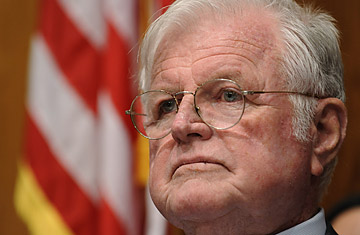
Senator Edward Kennedy
(4 of 8)
An emotional man, he became deeply devoted to his Catholic faith and his second wife Vicki. He even learned to view the brain cancer that eventually killed him as an odd gift--a gradual fading of a kind that would be easier for his family and friends to come to terms with than the violent and sudden loss of three brothers and a sister, Kathleen. He, at least, was given the gift of time to prepare.
The day after Thanksgiving in 2008, six months after his diagnosis, Kennedy had a party. He and Vicki invited about 100 people to Hyannis Port. Chemotherapy had taken a toll on Ted's strength, but Barack Obama's electoral victory had invigorated him. His children, stepchildren and many of his nieces and nephews were there. So were several of his oldest friends, men who had attended grammar school, college or law school with Kennedy. Family and friends: the ultimate safety net.
Suddenly, Ted Kennedy wanted to sing. And he demanded everyone join him in the parlor, where he sat in a straight-backed chair beside the piano. Most of the tunes were popular when all the ghosts were still alive, still there in the house. Ted sang "Some Enchanted Evening," and everyone chimed in, the smiles tinged with a touch of sadness.
The sound spilled out past the porch, into a night made lighter by a full moon whose bright glare bounced off the dark waters of Nantucket Sound, beyond the old house where Teddy--and he was always "Teddy" here--mouthed the lyrics to every song, sitting, smiling, happy to be surrounded by family and friends in a place where he could hear and remember it all. And as he sang, his blue eyes sparkled with life, and for the moment it seemed as if one of his deeply felt beliefs--"that we will all meet again, don't know where, don't know when"--was nothing other than true.
"I love living here," Ted Kennedy once said. "And I believe in the Resurrection."
Barnicle was a columnist at the Boston Globe for 25 years
The Last Lion BY TED SORENSEN
When I first met ted Kennedy 55 years ago, he did not initially seem to be much more than the "kid brother"--fun, funny, friendly, but not a major part of the genial Kennedy dinner-table conversations on policy and politics. When I last met with him, in the summer of 2008, he was the Senate's next-to-eldest statesman, convening a breakfast meeting to discuss his plan to establish a research institute or foundation for the scholarly study of the Senate, its history and role in American public life. I took that opportunity to present to him a copy of my new book of memoirs, Counselor: A Life at the Edge of History, with a personal inscription commending him on his accomplishments and predicting more in an even brighter future. In a few days, he graciously replied with a letter, closing with a prediction that an Obama victory would implement my ideals.