

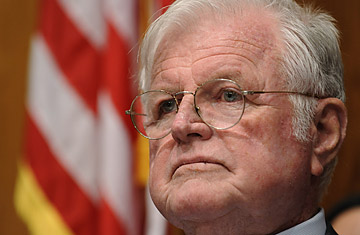
Senator Edward Kennedy
(7 of 8)
And no more so than the day we walked through Boston's City Hall Plaza together and got pelted with tomatoes thrown by some of his most loyal and mythic constituents--the aggrieved Celts of South Boston, whose children were about to be bused into a black neighborhood. Afterward, in his office, he offered me a towel to wipe the tomato off my ruined khaki suit and disappeared. But we talked again about that day soon after, and memorably so, since neither of us was sober. It was at a cocktail reception at Ethel Kennedy's home, for recipients of the Robert F. Kennedy journalism awards, one of whom happened to be me. In celebration, before the ceremony, a Kennedy who shall remain nameless took me down to the barn for an intense herbal experience. When I returned to the house, there was Teddy--and it was immediately apparent that he was as shiffazed as I was stoned. We greeted each other like old comrades in arms, sat in a corner and talked about how he wasn't angry about the tomatoes, about how sad and unfair it was that the Irish of Southie and the blacks of Roxbury had to endure busing while the rich kids out in the suburbs got off the hook. It was the first actual conversation we'd ever had. A picture was taken of him handing me the award, which has somehow, sadly, been lost. We were both smiling.
A few months later, I was back at Ethel Kennedy's house--living there as the deputy to Richard Goodwin, the JFK speechwriter who had been tapped as the Rolling Stone Washington bureau chief. On July 4 weekend, Hunter Thompson showed up, and I don't remember much else after that, except that a fair number of Ethel's children were involved. Word spread quickly, as word will do in Washington. That Monday, by coincidence, I had an appointment with Kennedy to talk about a story I was working on, and he said, "Joe, before we get started, can I ask you something off the record?" I said sure, and he continued. "What on earth is happening at that house?"
"Why nothing, Senator," I said, summoning all the false gravity in my tiny arsenal. He smiled, raised an eyebrow. "O.K., O.K.," he said. "I asked."
And I was with him the day he was liberated from ambition, finally. It was Feb. 26, 1980, the day of the New Hampshire primary. He was losing--an unimaginable event for a Kennedy, losing in New England. His campaign up to that point had, in fact, been dreadful. He had famously been unable to answer a simple question posed by Roger Mudd of CBS News, "Why do you want to be President?" Because I'm supposed to? Well, that was the truth, but it wasn't an acceptable answer. He had been every bit as shaky and unhappy on the stump as I'd seen him when he ran for Senate. He had blown a 35-point lead. He had been clobbered by Jimmy Carter in Iowa. And now, in New Hampshire, we landed in a small plane and an aide rushed up with the bad news about the early exit polls. He was losing again. "So much for the well-oiled Kennedy machine," he joked, and--I swear--almost immediately became a different person. The nomination was clearly lost, but he continued to fight on, stubbornly, disastrously for the Democratic Party, but he actually seemed to be enjoying it for a change. He gave the speech of his life, "The Dream Shall Never Die," at the Democratic Convention that year and began the far more satisfying Second Act of his life.