

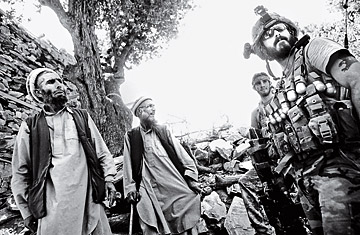
In the battle against the Taliban, U.S. Marines, seen here in the Korengal Valley, often face the ire of villagers who complain about mortar strikes on their homes
(3 of 3)
Taking the Long View
U.S. and Afghan government officials certainly know about the protection rackets. Afghan Deputy Minister of Public Works Mohammad Rasooli Wali freely admits that the contractors he has hired to help build the multibillion-dollar ring road around Afghanistan — funded by the World Bank, USAID and other nations' development programs — probably pay off the Taliban to protect their sites and equipment. For his part, Colonel Thomas O'Donovan, the departing head of the Army Corps of Engineers in Afghanistan, which is responsible for about $4 billion worth of U.S. government contracts a year, admits that there is little the Corps can do to stop subcontractors from paying the Taliban. "If we catch them, then they are done. But how do you catch them? It's not like the Taliban give receipts."
So what can be done? Cohen, at Treasury, says an interagency task force has recently been convened on the issue of funding extremists, hoping this will help "protect the critically important work of humanitarian agencies in the region." Flynn, who came to ISAF two months ago with General Stanley McChrystal, the organization's new U.S. commander, thinks the old laissez-faire attitude toward protection money has got to change. "This is happening on battlefields across Afghanistan," he says, "and we have to fix it. Because if we can't fix that, then we can't tell the government of Afghanistan to get its act together." Hanif Atmar, Afghanistan's Minister of the Interior, says increased financing, particularly through extortion, is emboldening the enemy and admits that part of the fault lies with his government. "Yes, I blame [contractors and construction companies] for the fact that they are paying these insurgents, but at the same time, I sympathize with them because they are not doing it out of their own accord but because they are forced to. It is our responsibility as the government of Afghanistan and the international community to provide a secure environment for them to work. And so far, we have not been able to do so."
That's in part because some Afghan officials think cracking down on protection rackets would be too difficult and costly, when an easier solution could be found in more development. Deputy Minister Wali says, "If the contractors pay the Taliban — well, that is only for a year, and the road is good for many years. And that brings security." Once the road is completed, he argues, it brings hospitals, police, schools and education. "And once the people know what the peace in the area is like, they will leave their guns and do some agriculture."
But that argument hasn't been borne out elsewhere. The Revolutionary Armed Forces of Colombia, or FARC, for example, has become so entrenched in the cocaine trade that it is now difficult to isolate the true ideologues from the criminals that keep the movement alive. The adviser to the Afghan Ministry of the Interior says the costs of enabling the Taliban's protection racket outweigh the benefits of any reconstruction that might come out of it. "It both prolongs the war and feeds criminality, which in turn turns more people against the government." His solution is to encourage local participation. "If you want a school, then make the locals build the school. You want a road, bring in local labor. It might be more convenient to pay off the Taliban, and it might be faster. But the community will protect what the community has built."
Such an approach would take time to bear fruit. The first step would be to shield local populations from the Taliban's threats — mission impossible without more Afghan and Western boots on the ground. Omerkhil, the beleaguered district governor from Char Dara, says there are only 27 police in his district of 80,000 residents "and 3,000 Taliban. The alternative to paying the Taliban is easy. If we had more soldiers, more police and more checkpoints, then I can guarantee you that the Taliban wouldn't be able to do anything."
In the end, only a thriving — and legal — local economy will turn off the Taliban's faucet. "If you have people making more money in a criminal organization than they can [make] working for the government or in the private sector," says a U.S. Treasury official involved in the issue, "it is an indication that we need to do a lot more to create a viable Afghan economy." Correct — and sadly, not something likely to be put right anytime soon.
— With reporting by Shah Mahmood Barakzai / Kabul
Download the new TIME BlackBerry app at app.time.com.