

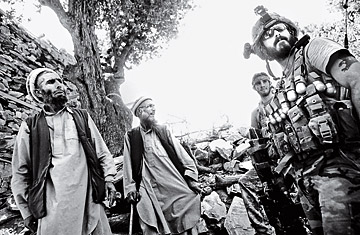
In the battle against the Taliban, U.S. Marines, seen here in the Korengal Valley, often face the ire of villagers who complain about mortar strikes on their homes
(2 of 3)
Afghans are learning the hard way how difficult it is to deal with this level of criminality. The day after the American soldiers died in Kunduz, Jan's construction site was hit. A bulldozer and 12 trucks were torched and two of the drivers caught by the Taliban and held for ransom. Jan, 72, with closely cropped hair, a thick white beard and a string of amber prayer beads, claims he was targeted in retaliation for not paying off the Taliban, even though the provincial governor and district governor say he did. Not that Jan would have refused — he says the Taliban never asked. "If the Taliban had asked for $100,000, I would have gladly paid them," says Jan. "This equipment was worth $230,000." What probably happened, says Abdul Wahid Omerkhil, district governor of Char Dara, where the attack took place, is that Jan paid off the wrong people. "It usually happens like that. You pay one group and you don't pay the other, and they will burn you."
Supping with the Devil
The situation in Char Dara, just 18 miles (about 30 km) from the provincial capital, Kunduz, has gotten so bad that Omerkhil doesn't even spend nights there. Taliban members openly walk the streets and demand usher, a religious tithe, in exchange for adjudicating disputes. From Char Dara, the Taliban is expanding throughout Kunduz. The Taliban's success in the province is attributable to the fact that it can raise money there. In the spring, Mullah Omar dispatched a Taliban "shadow governor" to Kunduz along with a handful of Uzbek, Chechen and Arab fighters, with the intent of threatening the transit of NATO supplies to Kabul. The arrival of Mullah Salam, the Taliban governor, coincided with the return of a local man, Shirin Agha, who had fled to Pakistan after he got into a gunfight at a wedding. While the commanders work independently, they share common tactics, demanding usher, kidnapping for ransom and taking cuts of construction projects. Sitting in the dilapidated foyer of his mansion, Mohammed Omer, the provincial governor of Kunduz, marvels at the scale of the two Taliban leaders' rackets. By his estimate, Salam and Agha amassed at least $100,000 in a month through kidnappings for ransom and protection payments from contractors, who in turn had been paid by international donors. "The problem is that the people here are demanding a school or a road or a bridge, and the foreigners want to help," Omer says. "If we don't build, the people complain, but if we do, this problem arises. Either way, the Taliban benefits." A foreign official in Kunduz who asked not to be identified says, "No one is going to come save these construction companies. The Taliban know that the international community is concerned about security, but they also know it wants to pursue development as much as possible. So extortion is the easiest crime."
It's not just the big foreign-aid projects that get hit. Local businesses are victims too. In Kandahar, says a businessman who asked for anonymity out of fear of Taliban retribution, even the smallest shops pay a "business license" to the Taliban. In his company, which builds towers for mobile-phone transmitters, he estimates that 20% to 30% of total costs go to protection payments. The going rate to protect a transmitter tower runs about $2,000 a month, he says. "You have no choice but to pay these guys. You don't want to do it, but there is no government in these areas, no security, so you have to do what you can to protect your business."
That analysis is confirmed by Sargon Heinrich, a Kabul-based U.S. businessman in construction and service industries. Heinrich says some 16% of his gross revenue goes to "facilitation fees," mostly to protect shipments of valuable equipment coming from the border. "That is all revenue that will ultimately be shared by the Taliban." As an American, Heinrich is troubled by the implication that he may be funding the insurgency. "All of this could be seen as material support for enemy forces," he muses. "But you have to weigh that against everything that is being done in that project. Are you aiding and abetting the enemy if you have to pay to get a school built? It's the cost of doing business here." In fact, protection payments are so widespread that one contractor I interviewed responded incredulously to questions about how the system worked. "You must be the only person in Afghanistan who doesn't know this is going on," he said.