

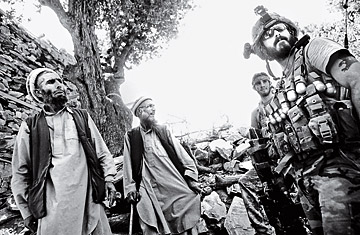
In the battle against the Taliban, U.S. Marines, seen here in the Korengal Valley, often face the ire of villagers who complain about mortar strikes on their homes
To understand why America and its allies are losing the war in Afghanistan, consider the story behind one deadly attack. On July 6, in the northern Afghan province of Kunduz, a powerful improvised explosive device, or IED, detonated under the wheels of a U.S. humvee. Four soldiers died, as did their translator and a bystander. The makeshift bomb was assembled with goods from the local bazaar. The man who placed it was probably paid the going rate of $750, according to government officials, or more if he captured video proof of dead soldiers. And though the local Taliban covered his expenses and fees, the cash very likely came from money donated by the international community to rebuild Afghanistan's roads, bridges, clinics and schools.
Just a week before the explosion, Hajji Lala Jan, a local businessman subcontracted by a local firm working for the German government — aid agency GTZ to build a road in Kunduz, handed some $15,000 in cash to a Taliban middleman to ensure that his project wouldn't be attacked, according to local officials — though Jan himself denies it. The Taliban cash flow has many sources, and it's impossible to say if German taxpayer dollars directly paid for that IED. Andreas Clausing, country director for GTZ, says such payoffs are "impossible. It is forbidden in our contracts, and we have very strict monitoring." Nevertheless, it is likely that a substantial amount of aid money from many countries — including the U.S. — has made its way, directly or indirectly, into the Taliban's coffers. "Here we have internationals and Afghans turning a blind eye to the fact that we are paying off the very Taliban that we claim to be fighting," says an adviser to the Afghan Ministry of Interior. "It becomes a self-sustaining war, a self-licking ice cream."
That war has become the most pressing overseas challenge facing the Obama Administration, which has already increased the number of U.S. troops in Afghanistan by 20,000 and is receiving pleas from top commanders to send even more. Barely a week after Afghans went to the polls to vote for a President, the results are tied up in accusations of fraud flying between the two leading candidates, President Hamid Karzai and former Foreign Minister Abdullah Abdullah. It will be several weeks before an official result is announced. But the political wrangling in Kabul is a sideshow to the increasingly lethal and effective campaign being waged by the Taliban. Drugs, contributions from private donors and — more and more — payoffs from local businessmen ensure that the insurgency stays robust. A Western official estimates that the Taliban is making more than it is spending, "and I don't want to even think about where the rest of that money is going." And as long as the money continues to flow, the war will go on.
Up to now, most explanations of the Taliban's funding have focused on its control of Afghanistan's poppy fields, which provide the raw material for heroin. Last month the CIA and the Defense Intelligence Agency released a report estimating that the Taliban receives about $70 million a year from the drug trade. But drugs aren't the whole story. "The Taliban obtains revenue from a variety of sources, including extortion of funds from both legitimate and unlawful activity," says David Cohen, the Treasury's assistant secretary for terrorist financing. Major General Michael Flynn, senior military intelligence official at NATO's International Security Assistance Force (ISAF) in Afghanistan stresses Mafia-like activities such as extortion and kidnapping for ransom. "I would say that there is more money going into the pockets of local leaders [of the insurgency] from criminal activities than there is from narcotics money," he says.
It's important to remember that the Afghan insurgency is not a cohesive movement but rather a loose affiliation of groups united by a common goal: the expulsion of foreign troops. Provincial rebel leaders are left largely to make their own plans and find their own funding. Drug money is more likely to go to national leaders of the insurgency, like Mullah Omar, who provide guidance and training for local groups. Local commanders, on the other hand, "absolutely raise their own funds through criminal activities to pay for food, IEDs, weapons and salaries," says Flynn. The billions of dollars spent on reconstruction projects are far too tempting a target to pass up. As a result, the Taliban, once an organization of seminary students seeking to establish a caliphate, is embracing criminal elements that feed on insecurity for financial gain. Together with poor governance, ineffective policing and a weak justice system, the nexus between the Taliban and crime is becoming dangerously entrenched in Afghan society. "The Taliban are acting like a broad network of criminal gangs that enables them to utilize different sources of income," says Ahmad Nader Nadery of the Afghanistan Independent Human Rights Commission.