

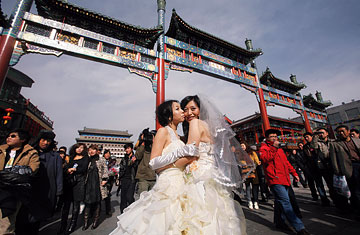
Making a scene
A lesbian couple stages a mock wedding in Beijing on Valentine's Day, 2009. Some gay people in China's capital use the holiday to campaign for greater acceptance of homosexuality
(3 of 3)
Despite this tacit backing, activists worked in a legal gray area. Section 377 of the Indian penal code, a law passed by the British colonial administration in 1860, criminalized sodomy and was still in effect, leaving gays vulnerable to the whims of local law enforcement. Police in Lucknow, a city in north India, arrested four HIV outreach workers in 2001 under Section 377 on charges including "conspiring to commit sodomy." The incident was alarming — but ultimately it served as the catalyst for a historic gay-rights ruling. The Naz Foundation filed a public-interest lawsuit on the arrested activists' behalf and after eight years of litigation, the Delhi High Court ruled on July 2 that Section 377 violated India's constitutional principles of equality and inclusivity. It was an emotional moment, particularly for those who grew up in more conservative times. "In those days, you just kept quiet about your sexuality," says Gautam Bhan, a New Delhi urban planner and activist. He lived in the U.S. for years, watching from abroad as India slowly changed, and went back in 2004 once he decided he could live in India as an openly gay man. "I still can't believe that 377 no longer holds," he says. "My landlord sent me a note, people in my office clapped when I entered the next day. There was this sense all around that it was obvious, it was good, it was right, it was a symbol of change."
Blending In
Even in authoritarian and deeply religious countries, gay people are finding ways to gather and meet each other, the first step in mobilizing for their rights. In Pakistan, where homosexuality is considered a crime by both the state and Islam, an underground social scene thrives among the élite, particularly in Karachi and Lahore. Inspired by activism in India, two women in Lahore earlier this year founded Pakistan's first gay-rights organization, whose members meet privately in affluent homes. China's authorities decriminalized homosexuality in 1997, but it is only in the last few years that gay culture has started to flourish. "The speed of change in China has been amazing," says a 37-year-old employee of a Beijing Internet company. It remains difficult to be openly gay in the workplace, says the man, who requested anonymity. But in social settings, the environment has improved dramatically, especially for young people, he says. "Some of them don't even think it's an issue." Still, there are limits. The Beijing Queer Film Festival has been held four times since 2001, and this year marked the first time that the event went off without any official interference. But Cui Zi'en, one of the organizers, said they "kept a deliberately low profile" this year by moving the festival to an outlying neighborhood.
To further their cause, gay activists in Asia have had to adapt, as Cui did. They can't just borrow strategies honed during the U.S. civil rights movement as others have done — in countries where democracy is still a work in progress, they have to invent new ones. Instead of confrontational tactics, they work hand in hand with other activists. Pradeep Khadka, human-rights coordinator for the Blue Diamond Society, says that rather than challenging Nepalese society, his group has built alliances within the democracy movement and tried to change attitudes and policies through political persuasion. Even the language of the movement is different. Instead of gay liberation or gay pride, Khadka promotes "sexual diversity" and the protection of "sexual minorities" along with the poor, women and lower castes. "We are not very aggressive," Khadka says. "It's a very soft way of approach." He admires the pioneers of the U.S. and Europe, but doesn't consider them models. "The generation has changed from the Stonewall movement."
This might be a soft revolution, but it is a revolution all the same. Some 200 openly gay, lesbian and transgender Nepalis gathered recently in a hotel conference room to draft sample legislation protecting their rights. Pant was there, hovering in the background, but the crowd was more interested in getting answers from the two straight politicians who were attending to hear their complaints about support for gay students and delays in getting passports marked "third gender." Nepal's example is powerful enough that donors from Norway and Sweden want to help them replicate it elsewhere. That effort will begin on Aug. 18 with a meeting in Kathmandu of gay activists from all over South Asia. It's hard to say what the gay world in Asia will look like a decade from now, but in a valley in the shadow of the Himalayas, it is finding its next incarnation.
— with reporting by Jessie Jiang / Beijing, Coco Masters / Tokyo, Madhur Singh / New Delhi and Omar Waraich / Lahore