

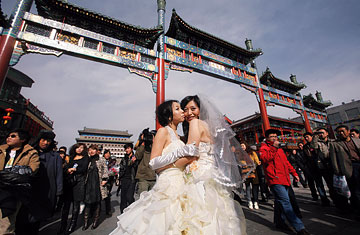
Making a scene
A lesbian couple stages a mock wedding in Beijing on Valentine's Day, 2009. Some gay people in China's capital use the holiday to campaign for greater acceptance of homosexuality
(2 of 3)
The Road Less Traveled
Pant's journey from rural Nepal to Kathmandu's parliament — with detours through a college campus in Belarus and the nightclubs of Tokyo — reveals how one gay man and his community came to terms. By leaving Nepal as a young college graduate, he experienced for the first time both homophobia and acceptance. In 1992, he went to Belarusian State Polytechnic Academy in Minsk to get his master's degree in computer science. The newly independent country, which had been part of the Soviet Union, welcomed students from the developing world, but he arrived at a time of growing hostility toward homosexuals — a banner at the college's medical clinic warned "Beware of Gays." He spent five years hiding who he was. "I understood that my sexuality could be a problem to the authorities and I could be deported," he says.
After completing his degree, Pant decided to take a trip to Japan as a volunteer for an environmental group. In Tokyo, what was originally scheduled to be a two-week sojourn stretched to three months as he immersed himself in one of Asia's most established gay subcultures. Homosexuality has a long history in Japan, with allusions to it documented as far back as the 11th century Tale of Genji. Attitudes changed with the growing influence of Christianity in the 1800s, but since the 1880s Japan has not had laws punishing homosexuality like those passed throughout the British colonies during the same period.
This quiet tolerance doesn't include legal rights or full social acceptance, but it does allow Japanese gays and lesbians a limited freedom. Tokyo has long had its own Chelsea in Shinjuku 2-chome, a neighborhood full of shops, nightclubs and bookstores catering to gay people. That's where Pant read about the 1969 Stonewall riots in New York City's Greenwich Village, an uprising against police harassment that many consider the beginning of the gay-rights movement. In Tokyo, Pant also discovered ancient Hindu texts celebrating same-sex love. When he returned to Nepal, he used this knowledge to explain to his parents that homosexuality was part of Hinduism's old traditions. This made coming out to them easier. "They had some questions," he says. "But when you talk about culture, about religion, it's not something foreign, somebody telling you something from outside."
His mother's worst fear, Pant says, was that he would be a victim of violence. "She was terrified," he recalls. After the Supreme Court ruling in 2007, such incidents are rare, although his parents still get upset when his political opponents make derogatory comments. Those are among the few intrusions into his otherwise ascetic life. His longtime partner recently moved to Bangkok, so he lives with his parents and grandmother in Kathmandu, spends time with his nieces and nephews, and visits his village regularly.
In Nepal, as in the rest of the world, the fight for gay rights is closely linked to the fight against HIV and AIDS. The deadly virus was initially tagged as a "gay disease" in the West, and its early victims struggled against a blatant and sometimes violent backlash. In Asia, homophobia took a different form: denial. For years, authorities asserted that HIV couldn't be a problem because homosexuality simply didn't exist. But by the late 1990s, it was obvious that HIV/AIDS posed a serious public-health threat that would only get worse if ignorance remained official policy. It's no coincidence that Pant's Blue Diamond Society initially worked on AIDS issues. Because of a global effort by public-health authorities and governments to raise HIV/AIDS awareness, "it was where we could get funding," Pant says.
This support gave him a platform to organize the local gay community — as it did for pioneers in the gay-rights movement in other countries. Anjali Gopalan, an activist in New Delhi, was there at the beginning of HIV/AIDS-awareness efforts. Trained in political science and international development, she moved to New York City in 1985 at the height of the AIDS epidemic and was involved in some of the first attempts to bring information about the disease to immigrants and the poor.
The experience proved to be a personal awakening. "It makes you learn a lot about your own culture," she says from a brightly painted office in south New Delhi, "to understand discrimination, to understand equality, to learn how to respect differences." After Gopalan returned to India in 1994 to be closer to her aging parents, she started the Naz Foundation (India) Trust, one of the country's first HIV/AIDS groups. Well before India's economic boom or the push to decriminalize gay sex, the movement helped to introduce issues concerning sexual orientation and sexuality into India's public discourse. "The government itself was funding programs for men who have sex with men," she says.