

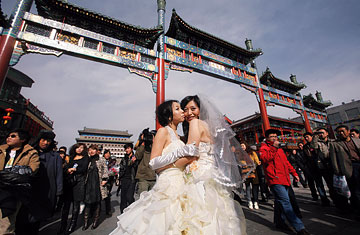
Making a scene
A lesbian couple stages a mock wedding in Beijing on Valentine's Day, 2009. Some gay people in China's capital use the holiday to campaign for greater acceptance of homosexuality
Sunil Babu Pant is a schoolteacher's son who grew up in the rough green mountains of central Nepal. The youngest of six children, indulged by his family, Pant remembers feeling attracted to other boys. But he wore that knowledge lightly, with the innocence of a sheltered child. Boys and girls played separately; Pant thought that his friends must feel just as he did. "It didn't appear as a problem to me growing up in the countryside," he says. "Even though I knew about myself, I couldn't define it."
By 28, Pant had a word for what he felt, and in 2000 he moved to Kathmandu, Nepal's capital, to find other gay people and some sense of belonging. What he discovered horrified him. After dark, a small underground subculture of gay men and women would meet each other in a few of the city's parks and ancient courtyards, gatherings that took place under a constant threat of violence by the police. A law against "unnatural sexual conduct" was often used as a pretext for harassment, he says. "It was such an unseen, unspoken tragedy that was going on every day."
Pant could have chosen to live as other gays do in Asia's conservative societies, hiding his sexuality behind a sham marriage while leading a dangerous double life. Instead, he decided to come out and to work against discrimination. "There was a choice to make," he says, "whether you feel threatened and live your life with misery, or you live with courage." In 2001, Pant and a few friends organized the Blue Diamond Society — named after the Diamond Sutra, a well-known translation of Buddhist teachings emphasizing compassion — to distribute information about HIV. The group later began documenting human-rights abuses against gay people, and its members sued to overturn Nepal's law criminalizing homosexuality. In December 2007, Nepal's Supreme Court ruled in their favor. Four months later, Pant, who was the main petitioner in the case, became South Asia's first openly gay member of parliament. By the end of 2008, the Supreme Court issued its full judgment, which not only nullified the old law but also established a "third gender" category for government documents. A newly formed government advisory committee is studying the possibility of legalizing gay marriage. In less than a decade, Nepal, a poor and devout Hindu kingdom, had become what the Indian writer and gay activist C.K. Meena calls "a gaytopia."
Rights and Recognition Nepal's transformation could only have happened in the first decade of the 21st century — and similar changes are taking place elsewhere in Asia as sweeping economic and social forces erode long-held prejudices. In India, the Delhi High Court recently struck down as unconstitutional a 149-year-old law criminalizing homosexuality, in a judgment so eloquent in its support of gay people's right to dignity that some wept in the courtroom as the last pages were read. In China this summer, Beijing and Shanghai hosted gay and lesbian festivals with little official interference — an achievement in a country where mass gatherings of any kind are tightly controlled. Tolerance isn't measured by any official statistic, but it's there in many forms — gay characters on television and in films, openly gay celebrities and gay public gatherings. Manila held Asia's first gay-pride parade in 1994; this year there were similar festivals in a dozen other Asian cities. "If nothing else, people aren't denying the existence of homosexuality anymore," says Jeffrey O'Malley, the director of the HIV group for the United Nations Development Program in New York City. "That's a huge difference from 20 years ago."
The rising visibility of gay people in the region is just one of many social changes that have been accelerated by travel, urbanization, education, democratization and, most of all, the explosion of information across every imaginable medium. This isn't simply Westernization — the old argument that homosexuality is yet another crass cultural import from the West has been all but discarded. But the Asian social institutions and beliefs that often stood in the way of tolerance — religious conservatism, intense emphasis on marriage and having children, cultural taboos against openly discussing sexuality — are weakening. In some parts of Asia, space is opening up for homosexuals in society. "The debate about sexuality is in the realm of the constitution, of democracy, equality and human rights," says Gautam Bhan, a gay activist in New Delhi. "The terrain of the debate has shifted."