

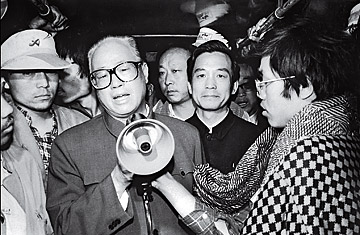
Knowing efforts will probably prove futile, Zhao pleads with students to "treasure their lives" and end their hunger strike.
When the tanks and troops blasted their way into Beijing's Tiananmen Square 20 years ago, crushing the student-led protest movement that had captivated the world, the biggest political casualty was Chinese Communist Party chief Zhao Ziyang, the man who had tried hardest to avoid the bloodshed.
Outmaneuvered by his hard-line rivals, Zhao was stripped of power and placed under house arrest. The daring innovator who had introduced capitalist policies to post--Mao Zedong China spent his last 16 years virtually imprisoned, rarely allowed to venture away from his home on a quiet alley in Beijing. As his hair turned white, Zhao passed many lonely hours driving golf balls into a net in his courtyard.
Yet as it turns out, Zhao never stopped thinking about Tiananmen. Through courage and subterfuge, he found a way, in the isolation of his heavily monitored home, to secretly record his account of what it was like to serve at China's highest levels of power--and more amazingly, he sneaked his memoir out of the country. Published this month, Prisoner of the State: The Secret Journal of Premier Zhao Ziyang provides an intimate look at one of the world's most opaque regimes during some of modern China's most critical moments. It marks the first time a Chinese leader of such stature--as head of the party, Zhao was nominally China's highest-ranking official--has spoken frankly about life at the top. Most significantly, Zhao's account could encourage future Chinese leaders to revisit the events of Tiananmen and acknowledge the government's tragic mistakes there. Hundreds of people were killed or imprisoned by government forces, though few Chinese today know the full story.
In the book, Zhao, who died in 2005, details the drama and conflict behind the scenes during the Tiananmen protests. The priority of the party's leaders ultimately wasn't to suppress a rebellion but to settle a power struggle between conservative and liberal factions. China's hard-liners had tried for years to derail the economic and political innovations that Zhao had introduced; Tiananmen, Zhao demonstrates in his journal, gave the conservatives a pretext to set the clock back. The key moment in Zhao's narrative is a meeting held at Deng Xiaoping's home on May 17, 1989, less than three weeks before the Tiananmen massacre. Zhao argued that the government should back off from its harsh threats against the protesters and look for ways to ease tensions. Two conservative officials immediately stood up to criticize Zhao, effectively blaming the escalating protests on him. Deng had the last word with his fateful decision to impose martial law and move troops into the capital. In a rare historical instance of a split at the party's highest levels, Zhao wouldn't sign on: "I refused to become the General Secretary who mobilized the military to crack down on students."
With his political career more or less finished, Zhao went to Tiananmen Square to talk to some of the tens of thousands of protesters massed there. Premier Li Peng, Zhao's primary rival, tagged along--though Zhao says Li was "terrified" and quickly left the scene. A teary Zhao spoke to student leaders through a bullhorn. "We have come too late," he said, urging students to leave the square to help calm things down. Few heeded his words. About two weeks later, the tanks and troops were sent in.