

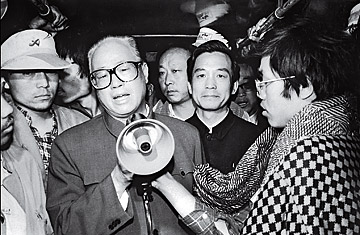
Knowing efforts will probably prove futile, Zhao pleads with students to "treasure their lives" and end their hunger strike.
(2 of 3)
When the assault on Tiananmen began, he could only wince as he heard the pop-pop-pop of automatic rifles near his home: "While sitting in the courtyard with my family, I heard intense gunfire," he wrote. "A tragedy to shock the world had not been averted, and was happening after all."
Zhao's effort to record and preserve his memoir required both secrecy and conspiracy. Under the noses of his captors, he recorded his material on about 30 tapes, each roughly an hour long. Judging from the content, most of the recording took place in or around 2000. Members of his family say even they were unaware that this was taking place. The recordings were on cassettes--mostly Peking opera and kids' music--that had been lying around the house. Zhao methodically noted their order by numbering them with faint pencil marks. There were no titles or other notes. The first few recordings were of discussions with friends. But most were taped alone, and Zhao apparently read from a text he had prepared.
When Zhao had finished the taping after a couple of years, he found a way to pass the material to a few trusted friends who had also been high-level party officials. Each was given only some of the recordings, evidently to hedge against their being lost or confiscated. After Zhao died four years ago, some of the people who knew about the recordings--they can't be named here because of fears of retaliation from Chinese authorities--launched a complex, clandestine effort to gather the material in one place and transcribe it for publication. Later, another set of tapes, perhaps the originals, was found hidden among his grandchildren's toys in his study.
The power structure described in the book is chaotic and often bumbling. In Zhao's narrative, Deng is a conflicted figure who urges Zhao to push hard for economic change but demands a crackdown on anything that seems to challenge the party's authority. Deng is at times portrayed not as an emperor but as a puppet subject to manipulation by Zhao or his rivals, depending on who presents his case to the old man first.
Once placed under house arrest, Zhao could do little but obsess over past events, rewinding the clock to pore over the technicalities of the state's case against him. His few attempts to venture out met with almost comically Kafkaesque resistance. For example, when authorities finally permitted him to play pool at a club for party officials, they first swept the place of other people, ensuring that Zhao played alone. His captors ultimately succeeded in keeping him out of view and silencing his voice, and they put up enough obstacles to deter all but the most determined visitors. As he said in his recordings, "The entrance to my home is a cold, desolate place."
Yet inside the gate, Zhao was busy at work, taping the journal that now gives him a final say about what really happened and what might have been. It's a fitting final act for a man who made enormous contributions to today's China. Although Deng generally gets credit for modernizing China's economy, it was Zhao who brought about the innovations--from breaking up Mao's collective farms to creating freewheeling special economic zones along the coast--that jolted China's economy from its slumber. And it was Zhao who had to continually outflank powerful rivals who didn't want to see the system change.