

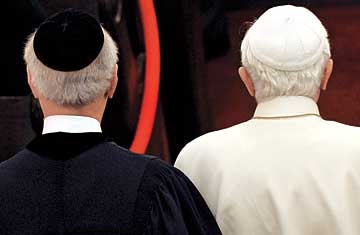
New York moment Benedict XVI, right, with Park East rabbi Arthur Schneier in April 2008, was the first Pontiff to visit a synagogue in the U.S.
(4 of 5)
Finally, there is Benedict's relationship to Vatican II's bedrock statement on the Jews, Nostra Aetate. Published in 1965, it said that Christianity "received the revelation of the Old Testament through" them, that they bear no collective or ongoing guilt for the death of Christ and that anti-Semitism is wrong--all teachings the Pope undoubtedly affirms. It also pointedly quotes St. Paul's New Testament preaching that God never retracted covenants he made with the Jews before the birth of Jesus. This contradicts the ancient church claim that Christ replaced (or "superseded") the Jews' divine connection--a position that exposed Jews to some 1,700 years of none-too-gentle Christian evangelizing and conversion.
The ongoing Jewish covenants--combined with points made in other conciliar documents--seem to temper the idea that Catholicism is a uniquely effective road to salvation that has little to learn from other traditions. But Benedict sometimes seems nostalgic for the old understanding. In 2006, for instance, he preached that in choosing 12 Apostles, Jesus was summoning the 12 tribes of Israel to be "reunited in a new covenant [Christianity], the full and perfect accomplishment of the old." There are harmless ways to interpret this. But it might also help explain why Benedict refused to delete the "conversion" wording from the Latin Mass.
The Cost of Indifference
On balance, Benedict is an admirer of the Jews, but one whose goodwill toward them may be moderated by his other concerns. Should that matter? "It's hard to imagine, but it's true that the Jews are not at the top of the agenda of everyone else in the world," quips Rabbi Jacob Neusner, a professor of Jewish studies at Bard College with whom the Pope has a fruitful scholarly relationship. One could justifiably wonder why, on an issue like the Latin Mass or SSPX, a busy Pope should constantly have to ask himself whether it's good for the Jews.
There are several good reasons. For one, as Merkel made clear, Germans have a special obligation. "We don't want [history] to repeat itself," as papal adviser Kasper says. The Holocaust also remains an affront to the self-understanding of Christians, and Western civilization as a whole. We learned the word genocide through the Jews. Since Vatican II, the Roman Catholic Church has set the post-Shoah standard in acknowledging the absolute unacceptability of the Jewish loss. Without the Catholic Church's leadership on the issue, other Christian groups might not have followed.
Since papal conclaves have a cutoff age of 80 and tend to elect Popes from their own number, Benedict is likely to be the last Pontiff who can say, "We remember," and mean it literally. As the church's center of gravity moves southward, he may also be one of the last European Popes, and Jewish relations tend to be low on the radar of African and South American bishops. (One of the latter recently said the Jews own the media.) When Benedict is gone, says Abe Foxman of the Anti-Defamation League, "not only may Judaism be off the agenda--it may face opposition. There's a clumsiness to how Benedict has dealt with some of these issues, and we really hope he fixes them while he's still here. Because the next guy may not be fixing any of it."