

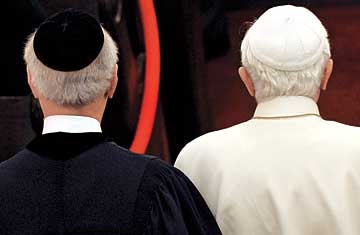
New York moment Benedict XVI, right, with Park East rabbi Arthur Schneier in April 2008, was the first Pontiff to visit a synagogue in the U.S.
(2 of 5)
Nobody thinks Benedict is an anti-Semite, and those close to him assert that aspersions on his enthusiasm are ridiculous. "He has written on the meaning of Judaism for Christianity," says Cardinal William Levada, his successor as Vatican doctrinal chief. "And he has also shown a fundamental sympathy that not even written words can have." But the Williamson affair was only the most recent episode in a series of gaffes and sour notes by the Pope. He seems simply to have forgotten Jewish concerns on a range of decisions regarding liturgy, sainthood and historical interpretation. In the case of SSPX, there is a distinct possibility that he knew full well he might offend Jews but went ahead anyway.
Rabbi James Rudin, senior interreligious adviser for the American Jewish Committee, notes that while "flash points happened with John Paul II as well, you always knew the Pope was committed to solving them. With Benedict, there's a sense of concerned bewilderment." Even after Benedict returns to the Vatican from the Holy Land, it's likely that he will still have to address skepticism about whether he shares John Paul's commitment to strengthening ties between Catholicism and Judaism--or whether he is willing to let his papacy be a tepid transition into a period of interfaith neglect.
The Missteps
Concern about the muddiness of Benedict's message first surfaced when he visited Auschwitz in 2006. Those attending the event were moved by his obvious emotion at the former death camp. But his address that day was marked by some highly peculiar ellipses. He failed to mention anti-Semitism, instead contending that "ultimately" the Nazis' motive in killing Jews was to "tear up the taproot of the Christian faith." And although he claimed to speak as a "son of the German people," Benedict seemed to downplay any ordinary-German implication in the Holocaust. Instead, he placed blame on a "ring of criminals [who] rose to power by false promises ... through terror ... with the result that our people was used and abused as an instrument of their thirst for destruction and power."
Both assertions are highly suspect. Although the German people as a group were not guilty of mass murder, neither were they innocent dupes throughout the process. And the idea that Hitler killed 6 million Jews to get at Christianity approaches the perverse. When Jewish groups complained, Benedict devoted a general audience to condemning anti-Semitism--although he revisited neither his church's nor his homeland's role in the Holocaust.
In 2007, the Pope raised eyebrows again, this time in widening the usage of the Tridentine Mass, commonly known as the Latin Mass. Jewish concern focused on the Tridentine prayer "for the conversion of the Jews," which is spoken on Good Friday, the anniversary of Christ's Crucifixion and historically an occasion for anti-Jewish riots. Benedict made some conciliatory changes in the prayer's content but refused to drop the stated objective of "conversion," infuriating some Jewish leaders, who saw it as an unnecessary provocation.