

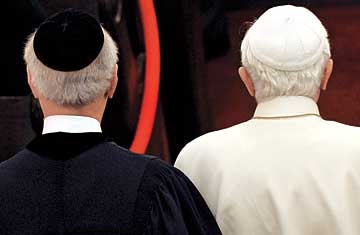
New York moment Benedict XVI, right, with Park East rabbi Arthur Schneier in April 2008, was the first Pontiff to visit a synagogue in the U.S.
(3 of 5)
Most troubling of all was Benedict's reinstatement of Williamson, a debacle whose full scope the Vatican seemed to recognize only the day after Merkel's upbraiding. The church demanded that Williamson recant his gas-chamber denial, and the Pontiff released a letter that deplored the strain between the church and the Jews resulting from his "mistake." He assured a visiting group of Israeli rabbis of his intent to deepen Catholic-Jewish relations and his belief that the Jewish people "were chosen as the elected people" to communicate fidelity to God.
Was that message sufficient? Rabbi David Rosen, the Jerusalem-based chair of the umbrella International Jewish Committee on Interreligious Consultations, says the Williamson affair is an "absolute gift" because it enabled the Pope to reiterate his affection for the Jews. Yet while Benedict may have been unaware of Williamson's Holocaust-denying interview, the Pope--who has been trying to pull the SSPX back into the fold for decades--must have been aware that anti-Semitism was something of an SSPX calling card. Says Eugene Fisher, a former Jewish-affairs expert for the U.S. Conference of Catholic Bishops, who generally lauds Benedict's dealings with Jews: "I think he should have had a notion that this would be a problem. The society website had all this [anti-Jewish] stuff in it." By all appearances, Benedict chose to ignore it.
The Past That Made the Pope
Any understanding of Benedict's subtle disengagement from Jewish questions begins in his youth. Joseph Ratzinger served a brief, mandatory stint in Hitler's Wehrmacht, but both Israel's Yad Vashem Holocaust center and the former East German secret police closed investigations into that part of his history without detecting any enthusiasm for Hitler's regime. Ratzinger's family was solidly anti-Nazi. But unlike John Paul, Ratzinger had no childhood Jewish playmates. His older brother Georg told German philosopher Raphaela Schmid, "I didn't know what a Jew was." That changed when their family moved from a small Bavarian village to the town of Traunstein, where in 1933, papal biographer John Allen reports, a DO NOT BUY FROM THE JEW sign hung in the main square. In an interview, Benedict recalled crowds threatening an Archbishop, "After the Jews, the Jew lover."
Cardinal Walter Kasper, the Pope's point man for Christian-Jewish affairs, says Benedict believes "Germans have a special obligation to do something more for the Jewish-Christian relationship." But it's not apparent that the Pope views the Holocaust with a sense of personal remorse. Wolfgang Benz, head of the Center for Research on Anti-Semitism in Berlin, notes that generalized remorseful feelings "started with [Germans] about 10 years younger" than the 82-year-old Pope. Members of Benedict's generation tend to judge themselves strictly on the grounds of personal culpability. Moreover, the Pope identifies heavily with his church, which he sees as having played a heroic anti-Nazi role. (History is far more ambiguous, although institutional Catholicism acquitted itself better than Protestantism.) As Catholicism's longtime philosophical enforcer, he holds even more fiercely than did John Paul to the belief that the church as a holy entity is perfect. He is less eager to critique the acts of its followers, especially since he may feel any admission of weakness could undermine his battle against European secularism.