

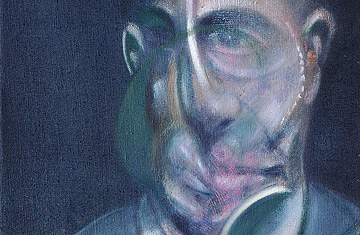
Portrait of Michel Leiris, 1976 Bacon's portrait of the French writer, a close friend, is a likeness that withholds as much as it tells.
(3 of 3)
Not everything he did is a triumph. In the mid-1950s, when he was spending a lot of time in Tangiers in a miserable love affair, he was inspired by Van Gogh and by the keen Moroccan sunlight to experiment with brighter colors and looser brushwork. The result was a series of congested Expressionist canvases that are the weakest in the show. But the high-key palette of those pictures also pointed him to the orange, lilac and beige backgrounds that make his great work of the '60s and '70s so unnerving, precisely because the figures struggle in such bright spaces.
By his last decade--he died in 1992--Bacon was almost too fluent in his own bleak idioms. There are cluttered, overdetermined pictures in the last galleries, where you watch him wondering how to make it new. But there are also great ones, like the 1991 Triptych. In all three panels, a large black square is placed like a window within a flat beige background. In the center, a barely human form flows over the lower edge of the black square. In each side panel, Bacon appears as a painted photograph of his own head pinned to the space above a pair of disembodied legs. Each of these has one foot stepping into the blackness. It's a portrait of the artist bowing out, dying as fearlessly as he lived. And when you see it without sentiment, even death can be majestic.
Culture Vulture Richard Lacayo blogs daily about art at time.com/lookingaround