

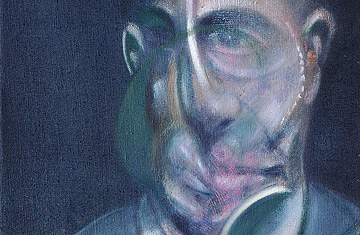
Portrait of Michel Leiris, 1976 Bacon's portrait of the French writer, a close friend, is a likeness that withholds as much as it tells.
Francis Bacon did for despair what Michelangelo did for faith. He made it majestic. That's the conclusion you can't help taking away from the Bacon retrospective that opened May 20 at the Metropolitan Museum of Art in New York City. I caught the show last year at its first venue, London's Tate Britain, and left it convinced that it was one of the most powerful exhibitions I'd seen in more than 40 years of museumgoing.
This has nothing to do with Bacon as the phenomenon of last year's hot auction market, now extinguished, where one of his triptychs sold for $86 million. By bringing together almost five decades of his work into a collective cry, this show makes you realize how rare it is to see contemporary art that attempts, much less achieves, what used to be called a tragic dimension. Irony you can find in any gallery these days, as well as low comedy, puerile cool and enigma. But in a time that has its share of suffering, where is the art that tries to strike an equivalent note? What we have almost no language for anymore, at least not in painting, is acute pain. Except in room after room of this magnificent show.
The exhibition, which runs through Aug. 16, marks the centenary of Bacon's birth in 1909 in Dublin. His father, a truculent British army officer turned horse trainer, shuttled the family for years between Ireland and England. But by the age of 16, Bacon was in London, and living on his own with a small allowance from his mother and the assistance of various older men. Eventually he drifted into a career as an interior decorator while trying to find his way as a painter. But it wasn't until the 1940s that he arrived at the vocabulary of tortured forms against a flat backdrop that he would develop for the rest of his life.
Along with Giacometti, Dubuffet and a few others, Bacon would emerge as one of the artists who found a way, after the butchery of World War II, to make the painted human figure plausible again by subjecting it to extreme pressure. The soft tissue of Bacon's men and women is wrenched and smeared by their own drives and desires and by whatever it is they do to one another. Their heads are split, their torsos are boneless. Their limbs, stretched and exploded, truly deserve to be called extremities--because with Bacon the body is always in extremis.
So in a triptych like Three Studies for a Crucifixion from 1962, with its invertebrate lovers grappling in the center panel and its butchered carcass in the right, the body is the visible sign of the eternal devils of human nature, the dog beneath the skin that bares its fangs in war and in bed. What the eyes represent for most painters, the mouth was for Bacon, the locus of human identity. The mouth is what bites, suckles, and howls at the moon. By contrast, the eyes are likely to be missing entirely or smeared shut or obscured by a milky scrim, as in his portrait of the writer Michel Leiris. With Bacon, the windows of the soul--not that he believed in the soul--always have the curtains drawn.