

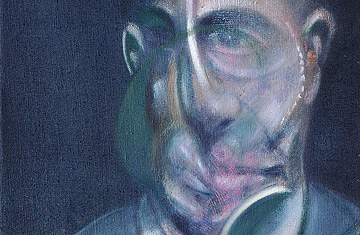
Portrait of Michel Leiris, 1976 Bacon's portrait of the French writer, a close friend, is a likeness that withholds as much as it tells.
(2 of 3)
To piece together his wretched figures, Bacon spent a lifetime ransacking art history. From Poussin he took the mouth of a screaming mother in The Massacre of the Innocents and from Degas the arched back of a woman bathing herself in a tub. Eadweard Muybridge's sequential photos of wrestlers gave him a perennial motif--sex as sexual combat. He also drew from sources far outside art. One of his favorites was an illustrated medical text about illnesses of the mouth. He worked from reproductions, movie stills and photographs of all kinds pinned to the walls of his studio and scattered on the floor in a sedimentary muck of paper, rags, used brushes and broken furniture that he would dive into for ideas.
But it was Picasso who first showed him the way. In the central panel of one of Bacon's works from the 1970s, Triptych--In Memory of George Dyer, a shadowy man stands near the landing of a darkened stairwell, turning a tiny key in a lock. That key is borrowed from an odd creature doing the same in several of Picasso's seaside pictures from the late 1920s, when he was flirting with Surrealism. Those elastic Picassos, with their biomorphic figures that are part human, part dirigible, part swollen breast or phallus, turned a key in Bacon. They showed him the way to his own nightmare distortions of anatomy.
Oddly, the steel-tube furnishings that Bacon favored as an interior designer in the '30s also found their way years later--in ghostly outline, stripped of any associations with fashion or taste--into the stark spaces and barred enclosures of his pictures. You detect them for the first time in his series of paintings from the 1950s that were drawn from the great Velázquez portrait of Pope Innocent X. Flickering white perimeters form a cage for the Pontiff's impotent fury. Why a Pope? With Bacon there's never one answer. His great gift was for visual and psychological conflation, for compressing multiple possibilities into a single sliding form. Trapped in a kind of isolation booth, where a thunderstorm of granular black strokes rains down on him, the screaming Pope in Head VI suggests the baying, baboon madness of authority. (One source for the image was a photo of Joseph Goebbels in full harangue.) Yet at the same time he's the face of the powerlessness of absolute power.
That picture of the Holy Father might also bear traces of Bacon's anguished dealings with his own father, who had rejected his girlish son. But it's a mistake to read Bacon's work too quickly by way of his life. That's true even of the ferocious triptychs he made after the suicide of his lover George Dyer, a onetime London hood who killed himself in their hotel room on the eve of Bacon's first big retrospective, in Paris in 1971. In those pictures Bacon didn't simply unload his grief. He used it to find his way to the even bleaker abbreviations of a pitiless world he produced in the 1970s. Dyer's grotesque end--he was found dead on the toilet from a drug overdose--stands behind these paintings, but they speak to you about more universal miseries. This is the thing so compelling about Bacon, the sense he produces that the suffering is ferocious but the sufferer is dry-eyed.