

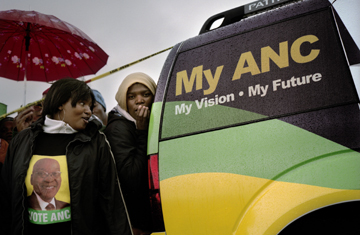
NEW HOPE: Despite his controversial past, Zuma remains hugely popular
(3 of 4)
Which makes it all the stranger that the ANC has done so little to improve the region. Today, much of the Eastern Cape is still typified by mud-walled, grass-roofed huts without running water, where boys ride horses, girls carry babies on their backs and families subsist on cattle, sheep, goats, chickens and maize. A new power grid has reached most homes--but supply is erratic. Many roads remain unpaved. In the town of Mthatha, 74% of the population earns less than $5 a day, and 43% is unemployed, according to a June 2008 report by the South African Medical Journal. In 2007, East London's Daily Dispatch newspaper revealed that poor maternity care at the city's Frere Hospital was resulting in around 200 stillborn babies every year--and that the corpses were being buried in mass pauper's graves. A tour of Mthatha General Hospital suggests equally grim conditions: paint peels from rotten ceilings, the floors are filthy, and in the casualty department an old woman lies slumped in her wheelchair in a pool of urine.
Then there is the violence. Parents in Mthatha don't let their children walk to school for fear of robbery or worse. The South African Medical Journal noted that Mthatha's murder rate was 133 per 100,000 in 2005, twice as high as that of Colombia and nearly three times the South African average. Sexual violence, too, seems disturbingly prevalent. Nobu Sipoka, director of the Mthatha Child Abuse Resource Centre, notes there are no precise data on the incidence of child rape, but says she founded the center because anecdotal evidence from doctors suggested it was unusually high. "It's symptomatic of the unemployment and the poverty," she says. "This is not a happy town." Walls and streetlights on the town's main drag, Nelson Mandela Drive, are plastered with posters offering SAFE ABORTION, SAME DAY and QUICK AND SAFE ABORTION, 3 HOURS, even a free lottery ticket with every 100% GUARANTEE, 2-HOUR procedure.
An hour away in the village of Mvezo, where Mandela was born 90 years ago in a small gathering of huts on a narrow, windswept spur, the Mandelas' immediate neighbors are outspoken about their disillusionment with the ANC. "My life was better during apartheid," says Vincent Ntswayi, 53, who held a steady job in Johannesburg during white rule but has only been intermittently employed since. "Freedom turned out to be just a word. Real freedom, real power, that comes from money--and I haven't got any money."
No Need to Perform
There are thousands of Mvezos in South Africa, hundreds of Mthathas and as many big-city townships. In its 2009 election manifesto, even the ANC admits inequality has increased. "There are a handful of extremely wealthy people whose lives have changed dramatically," Suzman told TIME before she died. "But the vast majority has been left behind. And there is a very clear link between that nondelivery and the violence and protests we experience. People are getting fed up, and understandably so."