

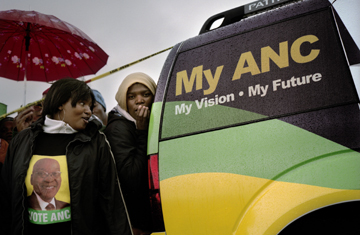
NEW HOPE: Despite his controversial past, Zuma remains hugely popular
On a warm summer's day earlier this year, South Africa's ruling party, the African National Congress (ANC), held a rally in East London, on the country's southern coast, to launch its campaign for re-election. Inside the city's stadium, in a pen between the stage and a sea of supporters in the ANC colors of yellow, black and green, stood the party's VIPs. Many of the men wore Gucci, and the women Prada, but mixed in with them were 60 or so people, of both sexes, in combat fatigues. Their camo caps identified them as veterans of Umkhonto we Sizwe (Spear of the Nation), the ANC's disbanded guerrilla wing. A well-dressed young man in a Porsche hat chatted with another in a scarlet T shirt that declared, "Let's all young people join the Young Communist League of South Africa to crush capitalism as a brutal system and replace it by communism." The parking lot was full of Range Rovers, BMWs and Mercedes-Benzes pasted with giant ANC stickers promising to BUILD A CARING SOCIETY--another testament to both the spoils and contradictions of power.
The ANC is expected to win a fourth consecutive term in South Africa's parliamentary and presidential elections on April 22. But for the first time since it came to power with the end of apartheid in 1994, that result is not a foregone conclusion. By any measure--popularity, membership, moral authority--the party of Nelson Mandela faces decline. The ANC's woes are a reflection of South Africa's own strange mix of progress and enduring crisis. Fifteen years after the end of white rule, the country remains Africa's economic and political powerhouse, and huge numbers of blacks are undeniably better off. Until the downturn, the economy was growing at a steady 4% to 5%. Millions of blacks have moved from clapboard shacks in townships to real homes, and the business capital, Johannesburg, has witnessed the emergence of a black middle class, even a black élite. But postapartheid South Africa has severe problems too. The country has the world's biggest HIV/AIDS population, 5 million; violent crime is endemic; and the black underclass has actually grown. In 2006, the South African Institute of Race Relations estimated that 4.2 million South Africans were living on $1 a day or less in 2005, up from 1.9 million in 1996.
Things have become more complicated for the ANC too. Factionalism and infighting led to a party split in November, when a group of disaffected members formed a breakaway group, the Congress of the People (COPE). There have also been scandals over corruption, incompetence and abuse of power. Nobel laureate Archbishop Desmond Tutu refuses to vote for the ANC, saying it has betrayed Mandela's legacy. Helen Suzman, a prominent white antiapartheid campaigner, called its performance an "enormous disappointment" a few months before her death on New Year's Day.