

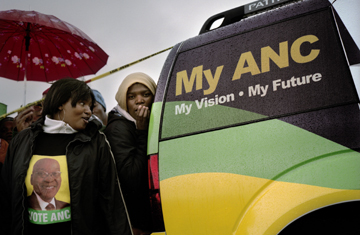
NEW HOPE: Despite his controversial past, Zuma remains hugely popular
(2 of 4)
To his critics, the ANC's new leader, Jacob Zuma, embodies the party's, and the country's, troubles. Zuma won the leadership in late 2007 after a vicious fight with his predecessor Thabo Mbeki that left the party divided and led to COPE's formation. In 2005, Zuma's business adviser, Schabir Shaik, was sentenced to 15 years in prison for soliciting bribes on his behalf, and for years, Zuma has faced charges of corruption, racketeering, fraud, money-laundering and tax evasion. Last month, Shaik secured an early release because of hypertension. On April 6, after three years of trying to bring Zuma to court, the National Prosecuting Authority dropped the case. State prosecutors denied yielding to pressure from the likely incoming Zuma government while arguing--after years of denial--that their case had been irretrievably compromised by pressure from the old Mbeki administration.
Zuma's supporters insist he is just the man to fight for the interests of those left behind in South Africa's first years of freedom. Still, there are questions about Zuma's commitment to racial reconciliation--famously, in a country still racked by racial violence, he chose the Zulu war anthem "Bring Me My Machine Gun" as a theme song--and his competence and judgment. He refuses to answer questions on policy, deferring instead to the ANC's executive committee. His coyness may be wise: those opinions he has aired have been startling. On trial for rape in 2006, a charge of which he was acquitted, he revealed that he thought taking a shower could prevent HIV infection. Among his supporters, all that only adds to his appeal. Zuma has a populist following in the townships, where his earthiness contrasts well with the élitism of Mbeki.
While business, civil society and the press provide far more of a check on government in South Africa than they do in, say, neighboring Zimbabwe, the party's critics see the same bad underlying dynamics at work. Andrew Feinstein, a former ANC MP who resigned in 2001 in protest over the way his party was frustrating an investigation into a corrupt $5 billion arms agreement (a deal from which Zuma was alleged to have benefited), says the past few years have seen a "regression in Africa's proudest democracy that seeps into some of those stereotypes of African Big Men." COPE founder Mosiuoa (Terror) Lekota says, "To fight for freedom, you need a liberation organization. But South Africa has moved on now. We need political parties than can deliver services to the people, not reward the loyalty of former activists."
Problems at Home
If there is one province of South Africa on which the ANC might have focused its efforts to build democracy and progress, it is the Eastern Cape, around East London. Drive out of the city and, after an hour, you descend into a steep, forested canyon along whose floor snakes the River Kei, the old boundary between white-run South Africa and the rolling prairies that apartheid authorities designated the black "homeland" of Transkei, meaning "across the Kei." During apartheid, the Transkei was a place of destitution: thousands of mud-walled, grass-roofed huts where people lived without running water, electricity or roads.