

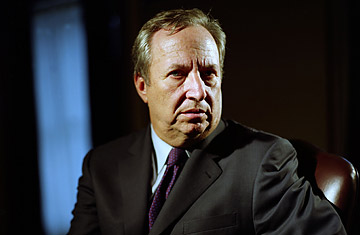
Summers is planning nothing short of a complete overhaul of the U.S. economy
(4 of 4)
As Clinton's last Treasury Secretary, Summers championed regulatory reforms that relaxed New Deal–era restrictions on banks — a shift that some economists have blamed for the current financial crisis and that Obama criticized during the campaign. None of these controversies gave the candidate pause last summer when he invited Summers into his inner circle for briefings on the deteriorating economy. As both a campaign and a White House adviser, Summers helped guide Obama's conviction that the economic crisis was an opportunity as well as a curse, a chance to accelerate many of his campaign pledges. In a column about the crisis published in September, shortly after he joined the campaign team, Summers laid out the fundamental thesis on which the Obama White House now operates. "For the near term," Summers wrote in the Financial Times, "government should do more, not less."
The prospect of unpleasant confirmation hearings made returning Summers to the top spot at Treasury an unappealing option in Obamaland. And so Summers was made director of the National Economic Council, which even in quiet times has a large staff and vast clout. He has already fallen into a steady routine, waking before sunrise at his northwest-Washington apartment, from which his wife Elisa New plans to commute to her job as an English professor at Harvard. (Each has three children from a previous marriage.) About 13 hours later, after meetings on a dizzying array of topics, he returns home to read reports from Congress or the Group of Thirty, an international body of economists, and call a network of peers who advise him. "I have aged, so I don't think I have called anyone after 11 o'clock since this job," he jokes about his reputation for having late-night debates with friends. "I'm not sure that's a record I will be able to continue."
— With reporting by Jay Newton-Small / Washington