

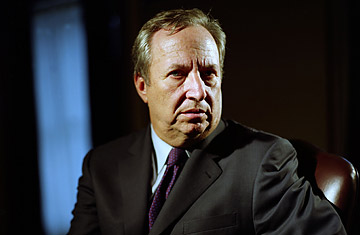
Summers is planning nothing short of a complete overhaul of the U.S. economy
(3 of 4)
As an economist, Summers has more credibility with Republicans than many other Obama officials do. He did an early stint in the economic back room of the Reagan White House and helped calm the markets during various mini-crises during the go-go 1990s. But Summers has long identified himself as a Democrat and has often leaned toward the left edge of the centrist economic consensus that has driven our recent financial history. "His solutions tend to be government-led, progressive structuring of the market for what he perceives as the greater social good," explains the new Treasury Secretary, Timothy Geithner, who was an Under Secretary for Summers during the Clinton Administration. "But he is also a firm believer in letting market forces lead the way."
More than anything else, say his peers, Summers is a ferocious debater, capable of unpacking four or five contradictory theories at the same time. "To have an argument with Larry Summers is a little like being run over by a tank with a Lotus engine and to find the experience educational," says Strobe Talbott, president of the Brookings Institution. Such pastimes may come naturally to the first son of two noted economists who was born in New Haven, Conn., in the shadow of Yale, and grew up in Philadelphia not far from the University of Pennsylvania. Not only did he become, at 28, one of the youngest tenured professors in Harvard history, but a decade later he also went on to win the prestigious John Bates Clark Medal, given to the best American economist under the age of 40. Both his critics and his fans admit he is usually the quickest thinker in even the most rarefied rooms, with a family pedigree that includes two uncles who separately won Nobels for economic science. "All of us are deeply resentful," Douglas Holtz-Eakin, the chief economic adviser to John McCain's presidential campaign, says with a laugh. "In terms of just genetic ability to do this — not fair."
But all that raw brainpower comes with handicaps as well, including a tendency to make verbal blunders that haunt Summers for years. As chief economist at the World Bank, he penned a memo explaining the "impeccable" economic logic of dumping toxic waste in developing countries, igniting a firestorm despite his protests that he was being sarcastic. Years later, as president of Harvard, he publicly raised the hypothesis that women have a less innate ability for science and math than men do, sparking a controversy that helped lead to his dismissal from the top job, despite repeated apologies and clarifications. "The stories are legend, and he definitely has some rough edges," says a former official who worked with Summers at Treasury. "I thought it was just that he was clueless, not really aware and not really thinking about his impact on people around him."