

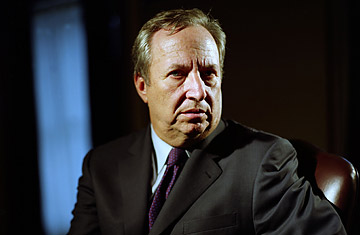
Summers is planning nothing short of a complete overhaul of the U.S. economy
The walls are still bare in Larry Summers' West Wing office, a cramped and cluttered perch overlooking the Rose Garden. The Bloomberg terminals have yet to be delivered, and the steam-powered White House e-mail system recently crashed. Add to all that the fact that much of Barack Obama's economic team is still finding its way around the White House, and it's somewhat remarkable that this economic wunderkind turned Obama adviser is moving at flank speed on the biggest restructuring of the U.S. economy since the New Deal.
By 3:30 p.m. on Jan. 27, Lawrence H. Summers has already been working for about nine hours, having checked the markets, read the newspapers, met with senior White House staff, finished his daily briefing to President Obama, visited both houses of Congress to discuss the stimulus plan and pulled aside a few Senators to lobby them personally. In days prior, he helped lead meetings on the banking crisis, the next federal budget, health-care reform, changes to Medicare and Social Security and a pending reregulation of the financial markets. The litany of crises would give an army of economists the shakes, but it doesn't seem to faze the 54-year-old Summers. "It's part of what makes it a challenging, exciting, interesting, daunting sort of opportunity," he says.
But with unemployment soaring toward 25-year highs, housing prices plunging and the nation's biggest banks facing insolvency, it is difficult not to wonder, Is Summers — is anyone, really — up to this herculean set of tasks at this impossible moment? And if the responsibility must fall largely on the shoulders of one man, does it have to be a guy in an ill-fitting suit who has a reputation for occasionally putting his foot in his mouth? The one who speaks in a disembodied patter while his nail-bitten fingers fiddle with his constant liquid sidekick, a can of Diet Coke? And then, just when you begin to ask yourself these questions, Summers starts speaking with an almost poetic clarity, in those perfectly formed sentences that have made him an in-house economist for three of the past five Presidents. "Any study of history reveals that with crisis comes enormous fluidity in the system," he says, a foot tapping now. "In Washington the transition from inconceivable to inevitable can be rapid if forced by events."
Since returning to Washington, he has expanded his turf so that it touches on nearly every area of domestic and international policy, from health-care reform to trade. Obama has elevated Summers to a level on par with the President's daily intelligence briefers, asking him to orchestrate work-ups each morning on the deteriorating economy. Robert Gibbs, the White House spokesman, refers to him in briefings as "Dr. Summers," with a deference that suggests Summers has powers out of science fiction. Stopped in a White House hallway in late January, David Axelrod, Obama's closest political aide, speaks with something akin to spiritual gratitude about having an intellectual like Summers around. "Quite frankly, I'm not sure we would have gotten him but for the fact that we have a crisis that is equal to his talents," Axelrod says. Summers, asked if he is up to the challenge, smiles and offers a diplomatic dodge. "I have confidence in what this President is able to do," he says.