

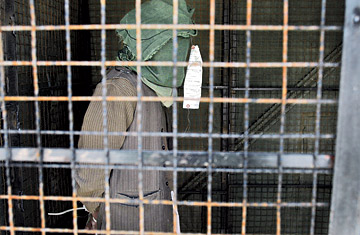
An elderly Afghan man detained in Ghazni, a former Taliban stronghold, by the U.S. Army in 2004.
(2 of 3)
Obama could fulfill his campaign pledge to close Gitmo by simply issuing an Executive Order. But that would pose the question of what to do with the 225 suspected terrorists detained there who would suddenly have no home. If brought to the U.S. for trial, they would fall under constitutional guarantees of due process, which includes the right to confront their accuser and review all evidence against them. That may not fly with top terrorism hunters, who rely on informants and classified evidence. Because some of the evidence looks to have been gathered during harsh interrogations that may now be regarded as illegal and therefore inadmissible in court, building criminal cases against some detainees may be impossible. That raises the danger of avowed terrorists walking away from U.S. custody on a technicality. "These are enormously complicated problems," says Benjamin Wittes, a Brookings Institution fellow. "It's very easy to say, 'Put everybody on trial.' But we still haven't figured out what our trial system looks like for these terrorism cases."
And even if Gitmo is shuttered, that still leaves the matter of those militants captured more recently in the wars in Afghanistan, Iraq and elsewhere whom Obama says he intends to more fully prosecute. Such knotty questions have led some experts to bet that while he will scale Gitmo back as quickly as possible, Obama won't fully close it in 2009. They point out that the Bush Administration has already quietly discharged some 500 of the 700 prisoners who have been held there.
Obama may opt to release dozens of others and insist that the remaining handful of high-profile cases be heard in either federal or military courts in the U.S. Already dozens of Guantánamo cases are moving through the federal court system following a pivotal Supreme Court ruling in June, and the Bush Administration is grappling with two separate rulings from federal judges ordering the release of 22 detainees.
Renditions and Secret Prisons
There is no doubt that the murkiest corner of the shadow war on terrorism has been the CIA's kidnapping suspected terrorists and shipping them to secret prisons around the globe--where obeying the Geneva Conventions is more an exception than the rule--a practice known as rendition. Unfortunately, some of those snatched by CIA officers were innocent. German citizen Khaled el-Masri was one such victim. El-Masri was vacationing in Macedonia in December 2003 when authorities arrested him on wrongful suspicions that his passport was fake. A tragic case of mistaken identity then played out. El-Masri has the same name as an al-Qaeda operative being hunted at the time by CIA officials, and they took custody of el-Masri in Macedonia. Operatives from the agency beat and drugged el-Masri before whisking him to a secret prison in Afghanistan known as the "Salt Pit." Eventually el-Masri's captors realized they had the wrong man and let him go, dumping him on a mountain road in Albania.