

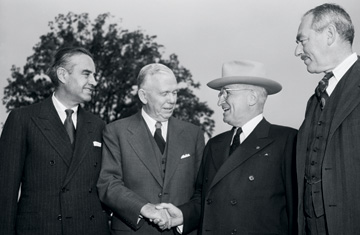
WISE MEN: In the post-WW II world, President Harry S. Truman (in hat) and, from left, Special Assistant to the President Averell Harriman, Defense Secretary George C. Marshall and Secretary of State Dean Acheson remade the global order by promoting multilateralism with American values
(3 of 3)
Nowhere is this more keenly marked than in China. I spend enough time in China to be able to say without equivocation that many of its cities are dystopian, that much of its natural environment is a poisoned wasteland, and that its government can be arbitrary and cruel. At the same time, never in human history are so many people improving their life chances so rapidly as in China today. Understandably, that is a source of immense pride to ordinary Chinese (not just in China, incidentally) and to their leaders. Sometimes this pride manifests itself as old-fashioned nationalism. But more usually it shows itself as a demand for recognition, for — to use that phrase again — just deserts. To be sure, Chinese leaders will often tell you that in some ways, great power status has come too soon to them, that they do not yet have the skills or expertise to handle difficult diplomatic challenges. But though modern Chinese will often ask for understanding, they will always ask for respect. They think they've earned it. And they're right.
This self-confidence of modern China, and other Asian societies, too, has had profound implications. At the most basic level, it has encouraged a wide-eyed admiration. In 2004, the World Bank held a global conference on poverty reduction in Shanghai, and I remember press reports describing the scene each evening. African delegates would gather on the Bund and look over the brown waters of the Whampoa to Pudong, gazing in wonder on an unearthly tableau of neon and skyscrapers built on marshes and paddyfields in not much more than 10 years.
What those Africans were seeing, of course, was not just a collection of extraordinary buildings — the world's highest hotel or a funky reworking of the Eiffel Tower — they were seeing a way of being modern. And that goes directly to the problem with claims of American leadership today. In the post-1945 world, the U.S. had a monopoly on modernity. Now it does not. There are, we have learned, many ways of being modern, and they do not all follow the path blazed by the U.S. This isn't just because in China — or in Russia, for that matter — the social and economic attributes of modernity have taken shape without the trappings of democracy, American style, though that is important. The same phenomenon is also evident in countries that are recognizably democracies. I have written before in TIME about a village in Crete that I have been visiting for more than 30 years. In the mid-1970s, there was just one paved street, the priest was the most important local figure, and there was a crisis among the local families when a girl student returned from college in Athens one summer wearing cut-off jeans. Now the streets are all paved and village children sunbathe in thong bikinis. The village is part of modern Europe. And I do mean Europe. Its sports and cultural heroes are not American, the political issues it cares about are not American, and its sense of the good life is not measured by 500 TV channels and huge McMansions. It has become modern, but its sense of modernity is largely unshaped by anything that the U.S. has done or has been.
This matters, because you cannot be a leader without followers. The end of America's monopoly on modernity, coupled with the pride that other nations and cultures take in their own versions of modernity, has changed the game. What the U.S. faces in the world now is not a crisis of leadership so much as one of followership. To be sure, the fiasco of Iraq has meant that there is no new generation of people and nations keen to follow America's lead. But the fundamental point transcends Iraq. It is that the conditions which created leadership and followership in the post-1945 world are gone, and they're not coming back.
None of this means that the U.S. is not the strongest power on earth; plainly, by any combination of measures it is. Often, other powers will want the U.S. to play a role far from its borders because that is the only way of getting things done. And I am certainly not arguing that the rest of the world should be anything but grateful for the leadership that the U.S. took on in the period after World War II. But the world has changed; the language and the concepts that made sense 50 years ago do not make sense now. The U.S. cannot expect an old debt of gratitude to be paid in the coin of perpetual deference. Nations outside the U.S. have no special need or want to hear claims for American leadership today. If those claims are made, they are likely — in American eyes — to be met with nothing more than a sullen ingratitude. Better for all if we just dispense with the whole idea and come up with something better.
It would be too much to ask those seeking the Presidency to embrace this reasoning. The leadership gene is too firmly lodged in the DNA of American politicians. But both McCain and Obama have stressed the need for a new and heartening approach to international relations. Even as he was calling for American leadership on everything from nuclear proliferation to global warming, Obama in Chicago spoke of the need for the U.S. to adopt "the spirit of a partner — a partner that is mindful of its own imperfections." And in his Los Angeles speech, McCain redefined leadership in a sophisticated way. "Leadership today," he said, "means something different than it did in the years after World War II, when ... the United States was the only democratic superpower. Today we are not alone. There is the powerful collective voice of the European Union, and there are the great [democracies] of India and Japan, Australia and Brazil. There are also the increasingly powerful nations of China and Russia. In such a world, where power of all kinds is more widely and evenly distributed, the United States cannot lead by virtue of its power alone ... We need to listen to the views and respect the collective will of our democratic allies. When we believe international action is necessary ... we will try to persuade our friends that we are right. But we in return must be willing to be persuaded by them."
The America that is sketched in passages such as that — one that does not claim a monopoly of wisdom; one that recognizes that the world has changed; one that does not argue that simply because America was founded on a great idea 232 years ago, it has a moral superiority over everyone else today — is an America to which others would listen. We will soon know if such an America is taking shape.
An earlier version of this article was given as the Howard Higman Memorial Lecture at the University of Colorado at Boulder in April, 2008.