

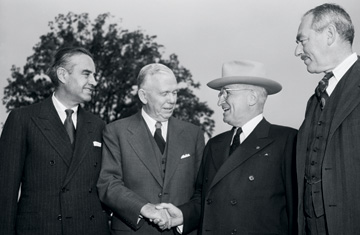
WISE MEN: In the post-WW II world, President Harry S. Truman (in hat) and, from left, Special Assistant to the President Averell Harriman, Defense Secretary George C. Marshall and Secretary of State Dean Acheson remade the global order by promoting multilateralism with American values
In the U.S. presidential election campaign, the speeches of the candidates on foreign policy have often turned on a single word, and a shared analysis. The word is "leadership," and the analysis is this. After World War II, the U.S. built an international system that protected those who signed up to its values, and that provided the means for contesting Soviet communism. Now, with the end of the Cold War, and in the messy world that has taken shape in its aftermath, it is time for America to show leadership again. In his set-piece speech on foreign policy in Chicago in April 2007, for example, Barack Obama identified no less than five ways in which the U.S. should lead the world. But John McCain made the point with greatest clarity in his speech to the Los Angeles World Affairs Council in March.
McCain said this: "President Harry Truman once said of America, 'God has created us and brought us to our present position of power and strength for some great purpose.' In his time, that purpose was to contain communism and build the structures of peace and prosperity that could provide a safe passage through the Cold War. Now it is our turn. We face a new set of opportunities and also new dangers ... The United States must lead in the 21st century, just as it did in Truman's day."
Beyond the assumption that the world today needs to see U.S. leadership just as it did after 1945, there has also been a second item of implicit agreement between the candidates: that the performance of the U.S. in its leadership role has been less impressive of late than it was following World War II.
It's hard to argue with that. During and after World War II, the U.S. encouraged the formation of multilateral institutions which spread a sense of collective political, military and economic security around much of the world. The Bush Administration, by contrast, has not been good at multilateralism or institution-building. Let's take some examples. It invaded Iraq without formal support from a United Nations Security Council resolution authorizing the use of force. While the U.S. has welcomed a host of post-communist nations into NATO, it has been unable to rally its allies, new or old, around a clear vision of what NATO's role is or what its future might be. And though, in the wake of the financial crash, President Bush has endorsed the French suggestion of holding a conference that might lead to new arrangements to govern the international financial system, it was the British government, not that of the U.S., that first understood that recapitalization of financial institutions was the key to short-term amelioration of the crisis.
This record of unilateral action and standoffishness has borne bitter fruit in terms of America's reputation overseas. The polls don't lie; even among its staunch allies, the U.S is seen as untrustworthy and dangerous. In his speech in Chicago last year, Obama said "I still believe that America is the last, best hope on earth. We just have to show the world why this is so." But in March, in an interview with the International Herald Tribune, Bernard Kouchner, France's Foreign Minister — and a true lover of America — took a different view. When the rest of world now looks at the U.S., Kouchner said, "the magic is over." Asked if the U.S. could repair the damage done to its reputation over the last few years, Kouchner replied sadly, "It will never be as it was before."
So why has American leadership been so disappointing in the post-Cold War years compared to the period after 1945? What has changed?
Leadership, we should note, is a word and a concept that is used much more often in and about the U.S. than it is anywhere else. The French have so much trouble with the idea of a leader that they often revert to using the English word. The Germans — for understandable reasons — do not boast of their own nation's führerschaft. But American politicians, of all stripes, have no problem in claiming a leadership role for the U.S. — in fact, they regard it as axiomatic that the U.S. should "lead" the world. As David Rieff argued recently in World Affairs, "President Bush has argued that the war in Iraq was a demonstration of America's moral leadership, whereas his liberal opponents claim that Iraq was where the U.S. forfeited its moral leadership. What no one questions is the certainty that we are capable of, indeed accustomed to, exercising such leadership, and, more basically still, that our ideals as a nation entitle us to do so."
The factors that once underpinned this claim, however, do not seem as strong now as they once were. Why not?