

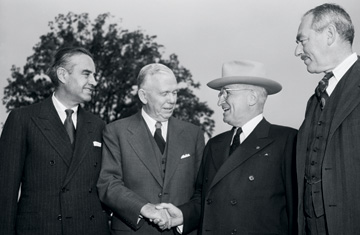
WISE MEN: In the post-WW II world, President Harry S. Truman (in hat) and, from left, Special Assistant to the President Averell Harriman, Defense Secretary George C. Marshall and Secretary of State Dean Acheson remade the global order by promoting multilateralism with American values
(2 of 3)
The difference between the end of World War II and the end of the Cold War cannot simply be one of personality. Those who put together the international settlement after 1945 — Harry Truman, George Marshall, Dean Acheson and the like — were indeed, in the title of a marvelous book by Walter Isaacson and Evan Thomas, The Wise Men. They were aware of their responsibilities and understood that American power would best be protected if it was shared in a network of institutions that made up a new liberal international order. Granted, George Bush is no Truman, nor Condoleezza Rice a Marshall. But to pin everything on personality ignores social and economic forces that have reshaped the shores of our world and our imagination. And in any case, it misses a significant change between the first term of President Bush and his second, during which the U.S. has relied much more on diplomacy, and much less on the use of force, to advance its objectives.
Underpinning much of that diplomacy has been the idea that democracy is a long-term cure for the instability that spills across national borders, as happened on 9/11. That intuitively makes sense. Democracies, because they institutionalize and internalize bargaining and the representation of different interests, tend to be peaceable. And democratic rights are popular. If the question is simply: Do people all over the world want the same trappings of liberal democracy that we enjoy — the right to choose our leaders, to think and say what we like, to worship how we choose? Then the answer is: Well, of course they do.
But liberal democracy is not all that people want. They want security — that is, quite simply to know that they and their families are safe. And they want justice.
That should not be surprising. Justice, after all, is an older concept than democracy; societies which had no conception of democracy as we know it nonetheless had sophisticated systems of justice. But it is important to distinguish two ways in which justice is relevant to claims of American leadership. First, there is a search for equity between the competing claims of individuals — the sort that might be made by a Palestinian farmer, for example, who has seen water from the local aquifer appropriated by an Israeli settlement. We ignore such claims, and the sullen outrage that accompanies them, at our peril. But there is a second sense in which people make a claim of justice, and this is as a collective — asking that a group to which they belong should receive their just deserts of respect, dignity and influence.
This gets us to the heart of the matter. When the wise men looked at their world in 1945, it was one of ruins. Germany and Japan had been destroyed. Britain was tired out; France shamed; Russia bled white. In China war would continue for another four years. Of the industrial democracies, only the U.S., Canada and Australia had been spared misery in their homeland. The U.S. economy accounted for nearly a half of total world output in 1945, a proportion that it has never approached since. Crucially, the U.S. defined what it was to be modern. The U.S. was big shouldered and handsome, the U.S. wore nylons and lipstick, the U.S. enjoyed a level of prosperity of which others could only dream. In Manhattan '45, her love letter to New York, Jan Morris writes "The old brag biggest and finest in the nation more and more evolved into biggest and finest in the world. Battered and impoverished London, humiliated Paris, shattered Berlin, discredited Rome — the old capitals towards which, before the war, Americans had so often looked with sensations of diffident inferiority now seemed flaccid beside this prodigy of the west."
In this context, it made sense to think, and speak, of "American leadership." If you were an American policymaker in 1945, you did not actually need to make a moral claim to leadership. You did not need to argue that because America was an idea, a city on a hill, the last, best hope of mankind, it had a right and responsibility to remake the world. It was much simpler than that. American leadership in the post-1945 world was not a moral aspiration, or a policy goal, at all. It was, as the Marxists would say, an objective reality, a fact that needed neither justification nor proof.
But that does not even come close to describing the world today. The American domination — economic, social, cultural, political — that was such a feature of the post-1945 world is missing now. Plainly, there are material aspects of modern American life that still inspire admiration from overseas, and features of American innovation that nobody else can match. But I spend about half my time outside the U.S., and I have to say that in many ways, like Bernard Kouchner, I think that the magic is gone. You want modern transportation systems? Try France or Japan. New airports? Half the cities of Asia. The old assumption that American culture would sweep the planet no longer holds good. In Africa and Asia, they don't cluster round TVs to watch baseball's World Series, but they do hang on every minute of every football game in the European Champions League.
Beyond anything else, though, it is the shift of the world's economic center of gravity from the Atlantic to the Pacific that has changed the environment. In 1945, Asia was typified by the rubble of war and the languidly racist torpor of colonial rule. Today, even making all appropriate allowances for a downturn in economies after the financial crisis, Asia remains the most dynamic part of the planet. Both India and China are growing at annual rates of more than 8%, and modernizing at a ferocious clip. China Mobile, the world's biggest mobile-phone company, adds more than 7 million new subscribers to its network every month. Companies like India's Tata and China's Lenovo — to say nothing of the sovereign wealth funds of Asia and the Gulf — routinely snap up icons of Western industry and commerce.
It is not really Asia's economic dynamism that is so important, however. It is the psychological consequences of economic success. The world, I often say to myself when I come home to New York from Asia, just looks better from over there. In Asia today, millions of people have a clear sense that their life is improving — that each year they will have some more creature comforts, maybe a car, maybe air-conditioning, and be better able to look after their aging parents or support their childrens' ambitions.
This economics made flesh is not just terribly moving — though it certainly is that. It also produces a sense of intense pride in those who are living it. It is that sense of pride — quite palpable throughout Asia today — that provides the demand for respect, for influence, for the nations that have achieved such economic success to receive their just deserts.