

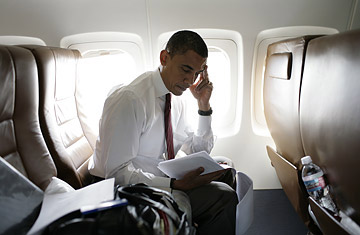
Senator Barack Obama looks over a speech on his campaign plane
(3 of 4)
And it's true that Obama doesn't have a thick record of businesses he has built or governments he has run. For one thing, he has moved around too much. The restlessness in his résumé is striking: two years at Occidental College, two years at Columbia University, a year in business, three years as a community organizer and then law school. Obama's four two-year terms in the Illinois state senate are his version of permanence, but in two of those terms, he was busy running for higher office.
Voters accustomed to evaluating governors and generals may have a hard time deciding what value to place on a stint of "organizing." But it was surely real work. Reading Obama's account of his efforts to organize the residents in a single Chicago neighborhood, with weeks of toil going into staging a single meeting, is like watching a man dig the Panama Canal with a Swiss Army knife.
As for his conventional training, friends of Obama's like to point out that 12 years as a lawmaker is more experience than Abraham Lincoln, the original beanpole from Illinois, had in 1860. They note that the issues Obama is most drawn to--health-care reform, juvenile justice, poverty--aren't the easiest. They tell the story of his artful arm-twisting and cajolery in the Illinois senate on behalf of bills to reform campaign-finance laws and require police to videotape interrogations. Obama worked his colleagues one by one, on the floor, on the basketball court, at the poker table, and managed to pass some difficult legislation. "He's unique in his ability to deal with extremely complex issues, to reach across the aisle and to deal with diverse people" one Republican colleague, McCain supporter Kirk Dillard, told the Wall Street Journal.
That wasn't enough to impress Clinton in the primaries. She enjoyed noting that Obama was chairman of a Senate subcommittee yet had never convened a substantive hearing. John McCain's campaign will not be any more dazzled. In a sense, the question of Obama's preparation hinges on data that are still being gathered, because his greatest accomplishment is this unfolding campaign. For a man given to Zen-like circularities--"We are the change we seek"--the best proof that he can unite people to solve problems might be his ability to unite them to win an election.
4. The Radical
Others believe Obama is like the clever wooden offering of the Greeks to Trojans: something that appears to be a gift on the outside but is cunningly dangerous within. They find in his background and in what he leaves unsaid telltale signs of a radical. Obama has worked on education issues in Chicago with William Ayers and has visited the home of Ayers and his wife Bernadette Dohrn. Both were leaders of the violent, leftist Weather Underground. But the indictment of Obama framed by his opponents starts years earlier in Hawaii, with the black man who told Obama that a true friendship with his white grandfather wasn't possible. The man's name was Frank Marshall Davis, and in the 1930s, '40s and early '50s he was a well-known poet, journalist and civil rights and labor activist. Like his friend Paul Robeson and others, Davis perceived the Soviet Union as a "staunch foe of racism" (as he later put it in his memoirs), and at one point he joined the Communist Party. "I worked with all kinds of groups," Davis explained. "My sole criterion was this: Are you with me in my determination to wipe out white supremacy?"
The conservative group Accuracy in Media (AIM) is eager to paint the radical picture. In press releases and website articles, AIM calls Davis "Obama's Communist Mentor," although by the time they met, Davis had been out of politics for decades, and "mentor" may exaggerate his role in the young man's life. Still, it's clear that Obama did seek advice from the old man and that what he got was undiluted. "You're not going to college to get educated. You're going there to get trained," Davis once warned Obama. "They'll train you so good, you'll start believing what they tell you about equal opportunity and the American way and all that s___." Did the future candidate take this to heart? Not according to him. "It made me smile," Obama recalls, "thinking back on Frank and his old Black Power dashiki self. In some ways he was as incurable as my mother, as certain in his faith, living in the same '60s time warp."
Obama's memoir displays more familiarity with the ideas of the far left than most American politicians would advertise. His interest in African independence movements led him to the seminal work of Frantz Fanon, a Marxist sociologist, and he speaks in passing of attending "socialist conferences" at the Cooper Union in New York City. But as Obama told TIME, this was in the Reagan years, and he was also reading works by conservative giants like Milton Friedman and Friedrich Hayek. He browsed among the ideologues but never bought in, he said. "I was always suspicious of dogma and the excesses of the left and the right."
Not all Obama critics see red, of course. Some merely believe he is more liberal than he claims to be. They cite a National Journal study, which Obama disputes, that rated him the most liberal member of the U.S. Senate, and they aren't dissuaded by the candidate's recent positions in favor of gun owners and an electronic-surveillance bill loathed by civil libertarians.
There is another Trojan-horse interpretation just below the radar. It is the idea that a man named Barack Hussein Obama might be hiding a Muslim identity. Obama has tackled this dozens of times. His Kenyan grandfather was indeed a Muslim; his father espoused no faith; Obama attended a Muslim school in Indonesia for a time as a boy because that's where he lived--Indonesia is a Muslim country. He believed in no religion until he moved to Chicago as a grown man and was baptized Christian by Wright. As campaign spokesman Robert Gibbs puts it, "His Christian pastor and this Muslim thing--how can he have problems with both at the same time? Pick one."
But that's the problem with having five faces. There's more than one to choose from. The "secret Muslim" rumors about Obama may be scurrilous, but they survived the sudden fame of Obama's card-carrying Christian pastor. A recent poll found that 12% of Americans believe them.
5. The Future