

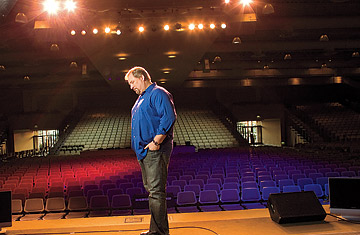
Home base Warren in a rare moment of solitude at his 23,000-member Saddleback Church.
(3 of 4)
The first nation to be so claimed—or to claim PEACE, really—was Rwanda. In 2005, Paul Kagame, who overthrew the genocidal regime of the small central African nation and later became its President, appeared at a celebration for Saddleback's 25th anniversary. Warren revealed that Kagame intended Rwanda to become the "first purpose-driven nation." Soon Saddleback members were commuting to and from Kigali, its capital. By the end of this year, 1,750 PEACE volunteers will have visited Rwanda. Not only have PEACE volunteers gone to work on health and development, Kagame says, but the more high-powered among them "use their contacts to draw on resources and attract investment. I can't have anything better than this." He admits that he is not a practicing Christian: "I cannot say I am devout, but I have a good sense of what faith is about and the usefulness of it." And in this case, he says, "what Saddleback is doing serves the church and serves us too."
Yet others, rather flatly, claim Warren's effort is invisible by the very terms on which he sold it. Visitors interested in the PEACE plan are still invariably flown not to a church but to the hospital in the town of Kibuye. PEACE is working with the University of Maryland to upgrade the facility and next year will give $500,000 as part of its province-wide $13 million commitment. But so far, aside from a paint job and some tidying up, there is little improvement. Laura Hoemeke, director of Twubakane, a USAID-funded Rwandan decentralization and health program, says, "Warren's people haven't done anything. For passing on information, mobilizing people, changing social norms, I think the church can be really effective. But ..." Others maintain that short-termers can't stay on top of the involved logistics of development.
PEACE representatives retort that 194 Rwandan health-care volunteers will begin making home visits in September. They also point to some working projects whose real-world performance exposes both the strengths and weaknesses of Warren's theory. In early 2006, Grant Bornzin, a Saddleback member, was in a PEACE group directed to a Presbyterian church in the village of Remera, where elders spoke of needing milk for children. The team went back to the U.S., and Bornzin admits that "the idea festered" for two years, until a team member returned to Africa and e-mailed that "they really need [a] livestock program." So Bornzin raised $14,000 from 45 Saddleback members and sent it to Remera with a detailed plan for stocking the area's neediest farmers and for the equitable distribution of the resulting calves. The effort appears to be working, and this month another missionary is back, installing water-purification units. PEACE's Rwanda field coordinator, Bob Bradberry, provides data indicating that there are 17 such church-based projects now operating in Rwanda.
The big question is, Why just 17? When Warren hears that other NGOs in Rwanda repeatedly told TIME that PEACE could offer no working examples of tangible aid-and-development projects, he laughs for 10 full seconds. "You were talking to the wrong guys," he says. Most aid-and-development experts, he claims, depend on Western-style measurements and reports. Rwandan churches, he says, have neither the time nor the obligation to produce them. Moreover, he asserts that executing a program involving spiritual goals through churches initially produces "results that tend not to be programmatic—they tend to be life change." (For instance, PEACE has recorded 10,000 baptisms in Rwanda.) Even when classic development programs are under way, he continues, "we don't sacrifice sustainability for speed. If you go back to my very first message in 2003, I said, This is going to take 50 years." He ADDS, "My confidence is not that I've got it all figured out. My confidence is, Jesus said, 'Do these five things,' and we've got the people out there." He is comfortable "building the plane as we fly it."
And it's that last statement, of course, that requires faith—in God, or in Warren. Even the pastor's harshest critics admit that he has a gift for picking good lieutenants and a near superhuman adaptability. A neat example of this is a document Warren has sent out called "PEACE 2.0," listing eight changes to his original plan. And while he once disdained working with existing Christian NGOs, he is now looking for ways to partner with some that can supplement his short-term army's wide-eyed enthusiasm with experience and cohesion. One NGO has already proposed running one of its programs through PEACE churches, a promising compromise.
The Balls-in-the-Air Question
The halting progress of Warren's PEACE program raises another question: Is he oversubscribed? I ask him how many countries there are in the world. Of course, he knows: "There's 195 countries." I think, 195 countries, and so far, even one seems to be a challenge. As Warren tallies it, he is just 28 years into a 40-year commitment to pastor Saddleback. He has written a holiday book, The Purpose of Christmas. He spent much of the past six months in 20 countries doing purpose-driven training and will be traveling to New York City in November, when 350 churches will do "40 Days of Purpose." As we speak, he is in Buenos Aires; yesterday was Brazil. His networking presents escalating opportunities, but of course, opportunities eat time. "It's the most amazing thing," he says. "I've had to ADD a new hat: my statesman hat. I had a call the other day from a President in Africa asking me to contact a President in Asia to set up a meeting." Then there's his business hat: "I put this unbelievably big deal together. The bottom line was $300 million." How did it happen? "A guy called me and asked me, 'Would you call this person?,' and I said, 'Well, it's not my role or anything I aspire to,' but out of it came this huge deal."
Warren may not aspire to global mogulhood, but he is clearly near giddy over occupying a globetrotting-catalyst status normally reserved for ex-Presidents. If he no longer wants to be the official pastor of the Republican Party, that's in part because he needs support from both parties for his various world projects. His new willingness to embrace causes regardless of their political implications places him firmly in the movement of New Evangelicalism, which remains socially conservative but has opinions on, say, Christianity in China that don't align with either political party's. (See the TIME poll, page 44.)