

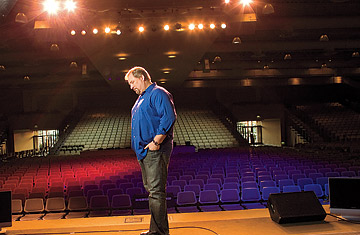
Home base Warren in a rare moment of solitude at his 23,000-member Saddleback Church.
(2 of 4)
But it was not until 2002 that Warren became a mainstream megastar, following the publication of The Purpose Driven Life. Beyond its striking opening assertion—"It's not about you" (it's about God and you)—the book, like its predecessor, was a crystal-clear blueprint, in this case for extending Sunday spirituality to the rest of one's life. It employed the tropes of the self-help genre (A 40-day program! Exercises!) to chart a user's guide to living midstream Evangelical doctrine. (On God's wanting believers to be a "living sacrifice": "The problem with a living sacrifice is that it can crawl off the altar. We sing Onward, Christian Soldiers on Sunday, then go AWOL on Monday.") The Purpose Driven Life shipped 40 million copies worldwide, and Warren was suddenly famous and (despite turning over 90% of his profits to his church) rich. He could try his hand at just about anything.
During the 2004 presidential election, he seemed to toy with using his new influence to become the next Jerry Falwell or James Dobson. Although he did not officially endorse George W. Bush, the mega-author made no secret of his preference. Two weeks before the election, he sent an e-mail to the several hundred thousand pastors on his mailing list, enumerating "non-negotiable" issues for Christians to consider when casting their votes: abortion, stem-cell research, gay marriage, euthanasia and human cloning. Shortly after the election, two attendees of a Washington meeting of conservative religious and political heavyweights remember Warren's actively soliciting advice on how he might increase his clout with GOP politicians.
But upon exploring the role, Warren grew uncomfortable with it. "I have never been considered a part of the religious right, because I don't believe politics is the most effective way to change the world," he says now. "Although public service can be a noble profession, and I believe it is our responsibility to vote, I don't have much faith in government solutions, given the track record. It's why I am a pastor, not a politician. None of my values have changed from four years ago, but my agenda has definitely expanded."
Warren had an epiphany in 2003. His wife Kay had dedicated herself to the fight against HIV/AIDS, a brave move in a community where it was still often stigmatized. In Africa with her nine months later, he says, he heard a message from above. "God said, 'You don't care squat about the sick and the poor. And you need to change; you need to repent.'" He became fond of repeating that the Bible has 2,000 verses dedicated to the poor and that the Gospel of Matthew contains not only the Great Commission, in which Christ bids his disciples to spread his word, but also the great commandment, in which he tells the Pharisees to love thy neighbor as thyself.
For Evangelicals who came of age during the Graham generation, notes Andy Crouch, head of the Christian Vision project at the Evangelical monthly Christianity Today, charitable mission work tended to be relegated to "occasional action to keep people alive, to teach them the Gospel in a credible way." Warren, by contrast, yearned for full-scale battle with the "five global giants": spiritual emptiness, selfish leadership, hunger, sickness and illiteracy. If he could provide the proper vehicle for change, millions might jump on.
Two options were immediately available. Most Evangelical do-gooding in the past century has been accomplished through Christian aid-and-development organizations like the behemoth World Vision. They work a lot like secular NGOs, maintaining a few dozen paid employees who manage long-term aid and community projects in poor areas for decades-long stretches. More recently, another model has emerged: each year, often during school breaks, about a million short-term volunteer missionaries in gangs of about 15 briefly saturate the Third World, enthusiastic if often ill-prepared, to build houses or dig wells and/or share the Gospel for about two weeks.
Warren's insight was to combine both models in a plan aimed at energizing Third World churches. He knew they were everywhere, including backwaters unreached by government or NGOs. He started comparing them to McDonald's franchises. Or to desktop computers: if they could be infected with the virus of good works, the world could be transformed. (Put simply: if every pastor in the world taught basic water hygiene, it could significantly cut rates of dysentery, a major global killer.) Scores of short-term activists, armed with Saddleback-crafted training, would go into a foreign country, locate its most promising churches and introduce them to the best practices in areas from health care to good leadership. Those churches would train other churches until the country was saturated. Warren saw this occurring in every country in the world.
PEACE—an acronym for promote reconciliation; equip servant leaders; assist the poor; care for the sick; educate the next generation—"exemplifies Rick's capacity to capture big ideas and make them simple and memorable and motivational," says Crouch. Indeed, the idea is so big, only Warren could have hatched it. Warren dismisses those who claim he is trying to "build heaven on earth." He says, "I'm not that stupid." But there is nothing in his sales pitch—to thousands of pastors, dozens of heads of state, financiers at the Davos World Economic Forum and editorial boards—that suggests where its limits might be. He refers repeatedly to the "1 billion" Christians he thinks the plan can mobilize. His sell combines the aid wonk's jargon of "self-sufficiency, scalability and reproducibility," the dotcommer's dream of exponential growth and something older. Says one pastor participant: "This is like the fishes-and-loaves story. People think that that kind of miracle is happening."
In May, Warren, who had been beta-testing the plan, held its "IPO." He convened 1,700 pastors from the purpose-driven network to Saddleback and urged them to send out teams as part of the "PEACE Coalition." "There was a lot of energy afterward," he says. "Guys with tears in their eyes. A guy was going, 'I'll take Mozambique,' and one was going, 'I'll take Nigeria.' They were dividing up the world."
The Rwandan Model