

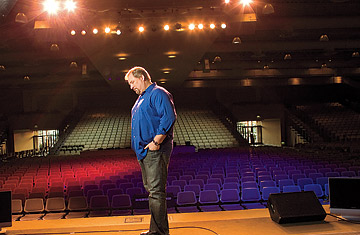
Home base Warren in a rare moment of solitude at his 23,000-member Saddleback Church.
Rick Warren has Rick Warren syndrome. That's not a joke. He has a brain disorder. "I was born with it," he says. "I went to the Mayo Clinic, and the doctors said, 'We have found a dozen or so other people with this. There's no name, so maybe we'll just call it the Warren syndrome." He describes the ailment's chemistry as an inability to process his body's own adrenaline. Its symptoms are tremors, disorientation and pain, and, as he says, "it makes my brain move very fast." I ask—since a colleague of his has asserted it—whether Warren also has attention deficit disorder. Warren laughs heartily. "Am I ADD? Yeah, I'm probably ADD too."
At this point in time, a lot of people may wish they could scatter their attention the way Warren does. He is the author of one of the world's best-selling books, The Purpose Driven Life, and the founding pastor of one of the country's largest churches, the 23,000-member Saddleback Church in Lake Forest, Calif. And on Aug. 16, he will play the role of national inquisitor in a "civil forum" featuring (consecutively, not in debate format) the two presumptive nominees for President, who will fly to Orange County, Calif., to be civilly grilled for an hour apiece.
A more cautious figure than Warren might have passed on the opportunity to become a political lightning rod. But he has spent the past few years positioning himself for just such a role as a suprapolitical, supracreedal arbiter of public virtues and religious responsibilities. Unlike some other conservative religious leaders during this long election season, he has remained conspicuously neutral on candidates. When he pushed to "unstick" an earlier stalled attempt to get John McCain and Barack Obama together, he did so by sending a personal "Let's do it" e-mail to each of them. The payoff is the Aug. 16 event, a kind of coronation for the 54-year-old, jovially hyperactive preacher. "It's remarkable. The candidates are according him tremendous status," says William Martin, author of the definitive biography of Billy Graham, A Prophet with Honor. "I don't see them doing it with an Episcopal bishop or a Cardinal—or another Evangelical."
If Warren is not quite today's Graham, who presided as "America's pastor" back when the U.S. affected a kind of Protestant civil religion, he is unquestionably the U.S.'s most influential and highest-profile churchman. He is a natural leader, a pathological schmoozer, insatiably curious and often the smartest person in the room. Like Graham, he projects an authenticity that has helped him forge an exquisite set of political connections—in the White House, on both sides of the legislative aisle and abroad. And he is both leading and riding the newest wave of change in the Evangelical community: an expansion beyond social conservatism to causes such as battling poverty, opposing torture and combating global warming. The movement has loosened the hold of religious-right leaders on ordinary Evangelicals and created an opportunity for Warren, who has lent his prominent voice to many of the new concerns.
A shift away from "sin issues"—like abortion and gay marriage—is reflected in Warren's approach to his coming sit-downs with the candidates. He says he is more interested in questions that he feels are "uniting," such as "poverty, HIV/AIDS, climate change and human rights," and still more in civics-class topics like the candidates' understanding of the role of the Constitution. There will be no "Christian religion test," Warren insists. "I want what's good for everybody, not just what's good for me. Who's the best for the nation right now?"
If Warren were content to be merely the most influential religious figure on the American political scene, that would be significant enough. He isn't. Five years ago, he concocted what he calls the PEACE plan, a bid to turn every single Christian church on earth into a provider of local health care, literacy and economic development, leadership training and spiritual growth. The enterprise has collected testimonials from Bono, the First Couple, Hillary Clinton, Obama, McCain and Graham, who called it "the greatest, most comprehensive and most biblical vision for world missions I've ever heard or read about." The only thing bigger than the plan's sheer nerve is the odds against its completion; there are signs that in the small country Warren has made a laboratory for the plan, PEACE is encountering as many problems as it has solved.
Having staked so much on his global initiative, Warren can't allow it to die. But the scale of his ambition does raise questions that confront the American Evangelical movement as a whole as it tries to graduate from a domestic political force into a global benefactor. In fact, it is easier to save souls than to save the world.
Big Church, Big Book
Warren Grew up in Northern California. He is a fourth-generation Southern Baptist pastor, intimately familiar not just with churches but also with the spreading of them: his father was a "church planter," or serial church founder. The son, who has said that from sixth grade on he was always president of something (and told TIME he led a courthouse march for the 1960s radical group Students for a Democratic Society, or SDS), received his own call to ministry at age 19. He got a conventional theology doctorate and an unconventional education from a friend, management guru Peter Drucker, who refined Warren's organizational gift and offered a secular vocabulary with which to express it.
Two archetypes dominated 20th century Evangelicalism: the Grahamesque evangelist, and the paladin of the religious right. Warren is neither. He has always been about churches. Networks of churches. And of pastors, the CEOS of churches. He founded Saddleback in 1980 when he was just out of Baptist seminary, with neither a building nor a congregation, and grew it relentlessly to its current size. In 1995 he shared his secrets in a book called The Purpose Driven Church: Growth Without Compromising Your Message & Mission. (The "purpose" was God's.) His knack for schematization allowed almost any minister to reconfigure his church along the lines of Saddleback. Warren says that he and his staff have given "purpose-driven training" to 500,000 eager pastors worldwide and that 1 out of 20 U.S. churches has done his "40 Days of Purpose" exercises. In all, says fellow megapastor Joel Hunter, Warren's is "easily the broadest and most influential church network in the world."