

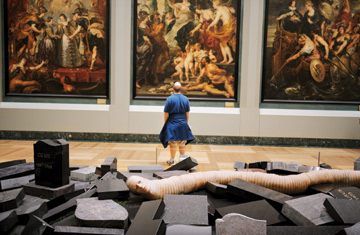
SHOCK THERAPY: Louvre director Loyrette is shaking things up by introducing controversial new works like Fabre's Self-Portrait as the World's Biggest Worm
(3 of 3)
The bottom line is that the Louvre has a lot more money to play with than in the past. Its annual acquisition budget has jumped from $4.5 million in 2004 to $36 million last year. Changes to French tax law in 2003 have helped: companies now have big fiscal incentives to make donations. But Loyrette has also built out the tiny three-man fund-raising department that Rosenberg set up in the late '90s into a full-time operation with 19 staffers. And the Louvre is about to launch a U.S.-style endowment fund — the first in France — using the money from the Abu Dhabi deal to ensure it can finance a bevy of ambitious projects in the future, including one that would revamp the entrance under the pyramid to make it easier for visitors to access the museum and get their bearings.
Indeed, just as in past eras when it flourished, the Louvre today is a busy construction site. Most of the work is taking place on a new wing dedicated to Islamic art, set to open in 2010 and partly funded by Saudi Arabia's Prince Alwaleed bin Talal al Saud and French oil giant Total. The Louvre is also building a branch museum in Lens, a depressed former coal-mining town in the north, as part of Loyrette's attempt to broaden its reach within France.
Nouveau Riche
If you ask Geneviève Bresc-Bautier, the crusty chief curator of the Louvre's sculpture department, what has changed in the Loyrette era, she'll grumble a bit about the heavier load of administration that comes the way of the museum's seven departments. She's also not convinced that appointing department heads for just three years at a time is a smart move. Until Loyrette came along, they were appointed for life. "Five years would be better. You can't get anything done in three," says Bresc-Bautier, who was appointed by Loyrette after her predecessor retired. But then she'll start to talk about the $3.7 million Austrian bust that the Louvre was able to buy in New York for her department, and the ambitious exhibition of French bronzes she'll be putting on later this year. Not to mention the restoration budget, which is "incomparably bigger than it was a decade ago."
Ultimately, this may be the big difference that Loyrette makes: for the first time in ages, the Louvre is feeling rich and motivated. Its fund-raising activities are already more aggressive than ever, but Loyrette is constantly looking to expand them. He persuaded Christopher Forbes, of the wealthy U.S. publishing family, to start up the American Friends of the Louvre at a time when France and the U.S. were sparring over Iraq. The organization has taken off and has just given birth to the International Friends of the Louvre. Among the guests at the June gala were the billionaire Mexican art collector Eugenio Lopez, Malaysian tycoon Francis Yeoh and Dasha Zhukova, the girlfriend of Russian oligarch Roman Abramovich. There's also money to be found in France: as well as campaigning vigorously to convince major French companies to contribute, Loyrette has created a circle of young donors that is attracting a new generation of entrepreneurs.
Which raises the question: Why should anyone give money to a French museum that already receives a hefty slug of government funding, while so many museums around the world are starved of cash? A few days after Cason Thrash's party, one of the attendees, Max Blumberg, a wealthy Floridian who made his money in lighting, sits in his exquisitely decorated Paris pied-à-terre opposite the Tuileries gardens, with a view of I.M. Pei's pyramid, and provides the answer. "The name of the Louvre has magical powers in the world of art," he says. "We don't look at it as France and America. The great world museums are global enterprises for all people." And then of course, there's Loyrette, constantly on their case. "He's a great seducer," Blumberg says, "because he believes so much in what he's doing." Indeed, as Loyrette has shown, running the Louvre is an art in itself.