

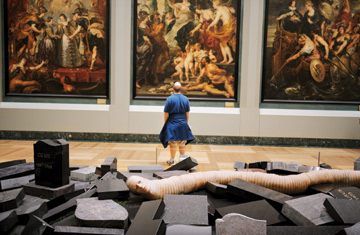
SHOCK THERAPY: Louvre director Loyrette is shaking things up by introducing controversial new works like Fabre's Self-Portrait as the World's Biggest Worm
Even by her own exacting standards, the black-tie gala that Houston socialite Becca Cason Thrash organized in Paris on June 10 was exceptional. The 272 attendees, who paid up to $10,000 each, included a smattering of European royalty, Bianca Jagger, Wall Street grandees Wilbur Ross and Stephen Schwarzman, and the cream of Houston high society. Thrash flew in her Los Angeles decorator, and says she was so nervous about the arrangements that "by 6 p.m. I was looking for a cyanide capsule." This wasn't any old fund raiser: it was held for the Louvre, in the Louvre — in the vaulted Galerie Daru at the bottom of the stairs leading up to the Winged Victory of Samothrace. There, seated at two immense mirrored tables decorated with yellow orchids — and surrounded by 2,000-year-old statues of Roman emperors, including a naked Julius Caesar — the guests dined on asparagus soufflé and veal noisettes before the grand finale: a charity auction and a Duran Duran concert held under the Louvre's landmark glass pyramid. The evening raised $2.7 million.
Until recently, France's iconic museum wouldn't have dreamed of rolling out the red carpet for international partygoers, however rich, let alone — quelle horreur! — allowing food and drink to be served in a gallery containing valuable artworks. Indeed, Cason Thrash's party was the first time that rule was broken. Fund raisers may be standard practice at American museums, but no American museum has a history as storied as that of the Louvre. It started life in the 12th century as an imposing fortress, then became a royal palace that was home for centuries to kings and their burgeoning art collections. In 1793, shortly after the French Revolution, it was turned into a museum that is now easily the most popular in the world; last year it drew in 8.3 million visitors, including more than 1 million Americans. That's 2 million more than the British Museum and almost twice as many as the Metropolitan Museum in New York, or the Vatican.
But times are changing, state funds are tight and the Louvre has an ambitious director named Henri Loyrette, who has given himself the mission of pulling the venerable institution into a new era. Tapping rich people around the globe for funding is just one of the changes Loyrette has brought about since he took over as director in 2001. Armed with a vision of the Louvre as a beacon of culture that is both accessible and global, he has set in motion a dramatic opening up to the outside world. So far, that includes signing a controversial deal to create a Louvre museum in Abu Dhabi, and staging exhibitions of the museum's treasures in places like Atlanta, Oklahoma City, Kobe, Valencia and Macao. He's also overhauling the museum's internal workings to make it more efficient, more financially robust and better able to cope with a surge in visitors — up 60% since 2001.
As part of this transformation, Loyrette and his chief administrator, Didier Selles, have trademarked the Louvre name and cut a deal with labor unions to end the strikes that used to shut the place down for a couple of weeks every year. Most controversially, Loyrette has also invited contemporary artists to exhibit at the Louvre and even decorate it — provoking howls of protests from French detractors.
All in all, it amounts to a mini-revolution at an institution that has been France's bastion of high culture ever since Charles V set up his library there in about 1360. Loyrette, 56, says his goal is not to be controversial just for the sake of it. But, he insists: "In a house like this you need to open the windows. We hadn't aired for a long time."
An art historian by training, Loyrette comes from a family of well-known French lawyers and spent more than two decades at the Musée d'Orsay in Paris, including seven years as its director. Some of what he's doing at the Louvre is experimental, he acknowledges — including the Abu Dhabi project, which he calls "a leap into the unknown." People often ask if he's planning to brand museums elsewhere, but Loyrette says he won't even contemplate other such projects until it's clear how well this one goes. (The Louvre Abu Dhabi is scheduled to open in 2013.) Still, he's a fervent advocate of sharing the Louvre's collection with a worldwide audience. From its beginnings as a museum over 200 years ago, he points out, it saw its vocation as being universal, not just French.
He's just as fervent about bringing in contemporary artists. He argues that they've long had a place at the Louvre, noting that both Eugène Delacroix and Cubist Georges Braque painted ceiling panels in the museum; Braque's 1953 paintings adorn a 450-year-old carved ceiling in the former royal antechamber. In the same vein, Loyrette has commissioned American Cy Twombly to paint one of the museum's last undecorated ceilings. "I'm not inventing or adding anything," he says. "In a way, I'm just renewing what has always been done."