

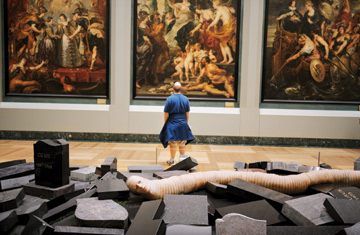
SHOCK THERAPY: Louvre director Loyrette is shaking things up by introducing controversial new works like Fabre's Self-Portrait as the World's Biggest Worm
(2 of 3)
There are still limits. The Louvre takes its public-service and scientific missions very seriously. A section of the basement hums with activity from workshops that keep alive esoteric skills such as the art of working with gold leaf, and curators say the increased number of exhibitions of Louvre works abroad keeps them on their toes, since they need to produce catalogues and other research for them. The lending policy isn't limitless, either: earlier this year the Louvre pulled out of a show that a private promoter was mounting in Verona, Italy. The Louvre would have received $6.4 million for loaning various famous pictures, including portraits by Titian, Raphael and Leonardo da Vinci, but the idea of working on a commercial basis with a private operator caused concern among some curators. When the promoter changed the venue, Loyrette withdrew.
Even Cason Thrash ran into restrictions on what she could do at her June party: the museum drew the line at using candles — she had to make do with battery-powered votive lights instead — and it also turned down her request to hold the event in a painting gallery. "They do that at the Met," she gripes. Still, Cason Thrash gushes about Loyrette, his embrace of American-style fund raising and his attempt to open up the place to a wider audience. "Henri's a visionary. He totally gets it," she says. "It's time for the Louvre to spread its wings."
The Earthworm Has Turned
Inevitably, some people have serious misgivings about what Loyrette is up to. Just ask Marc Fumaroli, one of 40 members of the Académie Française, the cream of the French intelligentsia, who are known as "the immortals." He's chairman of the Society of Friends of the Louvre, a 111-year-old French association that helps finance some of the museum's acquisitions. Its popularity has been waning, but with 70,000 members, most of whom pay a $100 annual subscription, it still has some clout — even if it doesn't formally have any say in the way the Louvre is run.
Sitting in his book-strewn office in the Collège de France opposite the Sorbonne, the white-haired Fumaroli is frank about the criticism. "The Friends of the Louvre is a milieu that is both cultured and demanding, and it easily gets into a bad mood," he says. There's particular concern about the way the museum is sending out its treasures. "Some think there is excessive exportation," is how he puts it — especially when money seems to be the primary motive.
Fumaroli's association isn't the only one to be concerned about that. The Abu Dhabi deal alone will bring the Louvre $900 million — $600 million for the right to use the Louvre name for 30 years, and the rest for services that include lending up to 300 works. (The total deal amounts to $1.3 billion; some other French museums participating in the government-backed project will share the rest of the proceeds.) When the deal was struck last year, an Internet petition declaring "our museums are not for sale" quickly drew several thousand signatures, including those of well-known curators and others in the French art world. The Louvre responded with its own statement, signed by Loyrette and all his department heads, promising that the accord didn't mark "the commercialization of culture, which all of us oppose." It's a tricky issue, Fumaroli concedes: "Some people are not in agreement [with Loyrette], but as one of the biggest museums in the world, the Louvre cannot escape the consequences of globalization."
The other big complaint is about the introduction of contemporary art. Fumaroli wrote an indignant piece in the French magazine Beaux-Arts about the biggest show to date, an exhibition by Belgian artist Jan Fabre that was held earlier this summer in galleries containing Dutch and Flemish masterpieces. Among the highlights: a table strewn with feathered sculptures depicting the severed heads of seven owls in the same room as Van Dyck portraits, and a gigantic earthworm wriggling on upended gravestones sharing a space with 21 Rubens depictions of Marie de Medicis. The show was part of a series called "Counterpoints," designed to give a new perspective on old works by putting them alongside contemporary ones. "It's important to have polyphony around the collection," says Loyrette. But Fumaroli trashed the Fabre works as pantalonnades — pantomime.
Displeasing the traditionalists might have had important repercussions in the past, but these days the museum can largely shrug them off. That's because, under Loyrette and his deputy Selles, the Louvre is becoming ever less dependent on France's establishment. The French state, which wholly funded the museum for much of its history, still subsidizes it generously, doling out about $180 million in 2008. But that's only about half the total budget. The rest is raised by the Louvre itself, from ticket sales, traveling-exhibition receipts, and above all donations by French companies and American and other philanthropists.
It's a process that started, slowly, under Loyrette's predecessor, Pierre Rosenberg, in the 1990s, when the government changed the Louvre's official status and gave it some limited autonomy. Loyrette and Selles have taken that opening and gone further, wresting management of the museum's finances and staff from government bureaucrats and, in exchange, signing a deal with the Culture Ministry that commits it to meet certain performance targets. In the past, the Louvre didn't even get the receipts of its ticket sales — instead, the money was put in a pot and divided up among all French museums. "We used to live in an absurd system, a universe that was completely archaic," Selles says.