

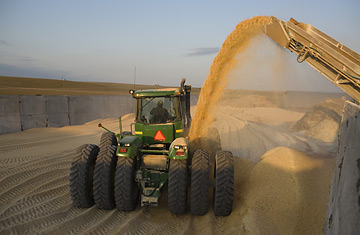
The Circle E farm, Belden, Nebraska
(4 of 5)
This is a legal and geopolitical issue as well as a moral one. Brazil has successfully challenged our cotton subsidies in the World Trade Organization (WTO), and a recent congressional report admitted "all major U.S. program crops are potentially vulnerable to WTO challenges." When U.S. officials urge the world to embrace free markets and free trade, the inevitable response is, What about your farm programs? "Our credibility is zero," says economist Daniel Sumner, a former Assistant Agriculture Secretary who runs the University of California's Agricultural Issues Center. "Every other country thinks of us as a liar and a crook."
We end up taking a hit in the global economy. In the Doha round of trade negotiations, the U.S. and Europe are supposed to slash farm supports, and the rest of the world is supposed to slash tariffs and other barriers on everything from cars to software to wood to wine to legal and financial services. But for several years, our reluctance to cut farm supports has stalled the talks, kneecapping American firms ranging from Microsoft to FedEx to Anheuser-Busch, and even American farmers who rely on exports. "The problem is a vested political constituency that's absolutely committed to the status quo," says retired California Congressman Cal Dooley, a former cotton and walnut farmer who leads the Grocery Manufacturers Association. "That's the main obstacle to free trade."
For all those reasons, Congressmen Kind and Flake proposed an amendment last summer to eliminate no-strings-attached direct payments, end subsidies to the rich, boost conservation funding and create a more targeted safety net for farmers having rough years. Kind thought they had a shot. A similar package had gotten 200 votes in 2002 without such a grand coalition, and this time Democrats--who had spent six years complaining about Republican giveaways to the rich--were calling the shots. Even the Bush Administration supported payment limits. During speeches to farm groups, Johanns kept displaying maps of all the subsidy recipients on Manhattan's swank Park Avenue.
But Kind thought wrong. "I got a real lesson in how Washington works," he says.
Game Over
EVEN BEFORE THE Agriculture Committee began work on the farm bill, chairman Peterson took Pelosi to meet with farm groups and warned her that Democratic freshmen in rural districts might lose seats if farm programs were revamped. Reformers countered with polls showing support for strict payment limits in those districts, and an analysis showing that most of those districts would receive more money under Kind-Flake through conservation payments. But as a Pelosi aide told them, it didn't matter whether the danger was real; it only mattered that freshmen Democrats believed it. The aggies flew in hundreds of farmers to lobby for the status quo, and several "Blue Dog" Democrats agreed to support Pelosi's efforts to fund children's health insurance with tobacco taxes only if she supported the status quo. Berry once called Pelosi late at night to beg her not to allow strict payment limits or any cuts in subsidies. "She said, 'Marion, this stuff is complicated, but if you say it's that important, I'll take your word for it,'" Berry recalls.
Pelosi ultimately pledged to support the work of the Agriculture Committee, whose members represent districts that receive 42% of the subsidies. "That was 'game over' right there," Kind says. "That committee is completely beholden to the status quo." The committee passed its bill without a dissenting vote.
How did Peterson achieve this consensus? By buying off the reform factions. California Representative Dennis Cardoza and the fruit-and-vegetable lobby agreed to support the bill once Peterson threw $1.6 billion at specialty crops. He added $4.7 billion for nutrition, $4.5 billion for conservation and $100 million for black farmers, which brought progressives, sportsmen and the Congressional Black Caucus into the fold. Even the Sustainable Agriculture Coalition dropped its opposition for scraps: $5 million for organic research, $22 million for organic certification and $30 million to help farmers sell value-added products. "The programs that really benefit small farmers are tiny, but the unfortunate fact of the politics is, if you want anything from the committee, you have to play their game," says Kari Hamerschlag, a sustainable-agriculture consultant.
Peterson still had to pay for the extras. He considered trimming the widely ridiculed direct payments, which were originally supposed to be transitional. But the methadone had become the heroin. "I don't like direct payments myself, but they're political reality," Peterson says. "I needed them in there to keep everyone on board." In fact, the House bill increased the maximum direct payment 50%. And cutting easier-to-defend payments for times of low crop prices was even less realistic.
So instead of cutting farm spending--which accounted for less than nutrition spending--Peterson persuaded Pelosi to pry money out of the Ways and Means Committee by closing a loophole that helps foreign firms duck U.S. tax liabilities. Republicans denounced this back-door tax hike to no avail. "They had every right to scream foul," Kind says. "There was no vetting in Ways and Means, no hearings, no markup. My party just grabbed $10 billion to buy off the opposition." Democratic leaders then squelched an amendment that would have forced an up-or-down vote on eliminating subsidies for farmers earning $250,000 a year. One lobbyist mused that General David Petraeus could learn something from Pelosi about crushing an insurgency.
Pelosi allowed a vote on Kind-Flake--or, as the farm groups called it, "Kinda-Flakey"--but this time it was crushed, 309 to 117. "I had two members tell me they felt sorry for Ron, I was stomping him so bad," Peterson said with a grin. "If I had put down the hammer, I could've taken him under 100." As they watched the debate, with its predictable tributes to hardworking family farmers, frustrated reformers filled out "Farm Bill Bingo" cards with aggie catchphrases like "farmer-friendly," "dismantling the safety net" and "East Coast media."
The Senate is expected to pass a similar bill soon. Bush will almost certainly veto anything with a tax hike, but it's not clear if he will block a status quo bill without one. For health, business and environmental groups, the farm bill is a compelling issue, but for the farm lobby, it's the issue, and politicians oppose it at their peril. The same flattery that irked Lincoln was on display last month at a National Farmers Union reception for members of Congress, who gushed about the farmers who had gathered to lobby against change. "Let me thank you again for the wholesome, wholesome inspiration you all are!" Pelosi shouted.