

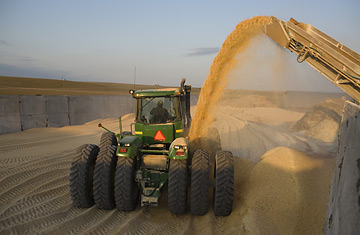
The Circle E farm, Belden, Nebraska
(3 of 5)
Most farmers say they'd rather not accept subsidies--if they didn't have to comply with so many government regulations, compete with subsidized farmers abroad and deal with commodity prices beyond their control. And don't get them started on the rising costs of their machinery, inputs and fuel. But their main arguments are that we'd spend more on food in a world without subsidies and that dependence on foreign protein would be even worse than our dependence on foreign oil. "The subsidies help keep us in business, so we can play in the dirt and you don't have to grow your own food," says Ben Boyd, a Georgia cotton farmer who's active in the Farm Bureau. "It's not like we're all living in plantations like Tara, wearing fancy white suits like Colonel Sanders."
But ensuring cheap food is not the real goal of the system. Farmers rightfully complain that they don't set food prices; they only receive a few pennies from the sale of every loaf of bread or box of cornflakes. When commodities are cheap, the main beneficiaries are well-heeled grain -and-livestock processors like Cargill, Tyson and Archer Daniels Midland. No, the real goal has always been to protect farmers from the vagaries of the weather and the market. Farming is indeed a risky business--most businesses are risky businesses--and farm policies have tried to reduce that risk by any means available. The result has been an evolving mix of income supports, price supports, disaster relief, government purchases of surplus crops for school lunches or foreign aid, and "supply controls" that boost crop prices by preventing overproduction. Such controls range from rules requiring farmers to leave some land fallow to acreage allotments directing them as to what and how much to plant. "If you can't feed and clothe yourself, your nation's at risk," says Arkansas Congressman and rice farmer Marion Berry. "Farming is a dadgum hard life, and we need folks to keep doing it."
For decades, this largesse was fairly uncontroversial. Georgians didn't like the sugar program, and Minnesotans rolled their eyes about cotton subsidies, but everyone made sure everyone else got theirs. In the 1970s, the House and Senate agriculture committees cleverly tacked food stamps onto farm bills to solidify the support of urban legislators. But when Republicans seized Congress in 1994, promising a revolutionary age of fiscal conservatism and free-market capitalism, they vowed to gut command-and-coddle farm policies that they compared to Soviet communism. They wanted the government to treat agriculture like any other business, and they said they'd offer farmers a deal: no more supply controls, so farmers could plant what they wanted, but no more subsidies, so they would have to survive on their own.
That was the deal enshrined by the Freedom to Farm law of 1996--except the part about no more subsidies. "The regular order took over," recalled Dan Glickman, a former Kansas Congressman who was President Clinton's Agriculture Secretary. "There was a lot of hefty intellectual discussion about weaning farmers off the dole, but of course, it didn't happen." Instead, GOP leaders agreed the next farm bill would wean farmers off subsidies but only after they received seven years of guaranteed transitional payments--even when prices were high. Farmers also received more generous crop-insurance subsidies so that Congress would no longer need to send them disaster checks every time their region had nasty weather. But when prices collapsed again in 1998, Congress approved the most generous disaster packages in history.
The 2002 election-year farm bill didn't wean farmers off subsidies either; it was the most profligate yet. It created new "countercyclical payments" for bad times, while extending transitional payments for all times, renaming them "direct payments" so no one had to keep pretending they were temporary. Texas Republican Larry Combest--then chairman of the House Agriculture Committee, now another agribusiness lobbyist--threatened to block legislation enhancing Bush's power to negotiate trade deals if he didn't sign the farm bill. Bush signed.
The result is that farm payments that used to cost a few billion dollars a year have averaged $17 billion. They'll be lower this year because commodity prices are so high. But owners of eligible farmland will still get direct payments regardless of how much their farms earn or whether their farms are still farmed. And even though crop-insurance subsidies have increased nearly tenfold, farmers will still receive disaster aid if things go badly, no matter how often that happens. More than 21,000 farmers have cashed at least 11 disaster checks each in the past 21 years, at a cost of $2.5 billion.
That's fine by Congress, which is considering a $5 billion "permanent disaster fund" to streamline these bailouts for persistent failures. "The system doesn't serve any consistent public-policy goal," says economist Bruce Babcock, director of Iowa State University's Center for Agricultural and Rural Development. "It only makes sense if the mission is finding ways to shovel money to farmers."
Mission Accomplished
CRITICS OFTEN EXAGGERATE THE IMPACT of farm programs, as if the Great Plains would become amber waves of arugula if only we stopped subsidizing King Corn. But government policies are supposed to reflect national priorities. Politics isn't destiny, but it does influence behavior on the margins. And in a country with 1 billion acres (40 million hectares) of farms and ranches, we've got big margins.
For example, health advocates ask why the most fattening calories on our grocery shelves are the most subsidized. During an unprecedented obesity epidemic, why not support fruits and vegetables instead of cattle and poultry feed? Similarly, green groups would shift funding from subsidies for the grain-industrial complex to conservation payments for eco-sensitive farmers of any size. The results would be less erosion; more restoration of grasslands and wetlands; and less degradation of water bodies like the Chesapeake Bay, the Everglades, the Colorado River and the Gulf of Mexico, where farm nutrients have created a 5,000-sq.-mi. (13,000 sq km) dead zone.
Another unintended consequence: we don't make West African cotton farmers poor, but our subsidies encourage overproduction that slightly reduces world cotton prices, making millions of them slightly poorer. An Oxfam study found that eliminating our subsidies could boost their average income as much as 5.7%, enough to feed two of their kids for a year. We spent $3.3 billion on cotton subsidies in 2005, more than half of Mali's gross domestic product. "We're not judging you--if we could subsidize our farmers, we'd do it!" says Abdoulaye Diop, Mali's ambassador to the U.S. "But you're hurting some of the poorest farmers in the world."