

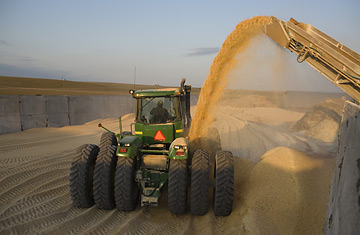
The Circle E farm, Belden, Nebraska
(2 of 5)
OUR CULT OF THE SMALL FAMILY FARMER dates back to Thomas Jefferson, who hailed humble "cultivators of the earth" as America's "most valuable" and "most virtuous" citizens. Politicians still paint American Gothic portraits of the country folk who toil in the soil to grow our food and fiber. But at the Husker Harvest Days farm show in September in Grand Island, Neb., it was clear how far American agriculture had come from the days when Cornhuskers husked corn by hand.
The farm show looked like a state fair but felt like an industry expo, with barkers urging visitors to increase productivity or cut costs rather than ride a pony or eat corn dogs. John Deere salesmen showed off their largest machinery ever, including a 530-horsepower tractor and a combine that costs $410,000 fully equipped. At the Firestone tent, a rep said the company is preparing a 91-in. (230 cm) farm tire, taller than Yao Ming. TopCon Precision Agriculture exhibited GPS gadgets that adjust your spraying and watering according to the topography of your fields and can even steer your tractor. ADM Financial advisers showed how to hedge risk in futures markets, while a lecturer at Monsanto's Biofuture tent touted drought-tolerant corn: "We're in a brand-new world here, folks! You've got to get more production out of every acre just to keep up!"
Jefferson's "cultivators of the earth" didn't have genetically engineered seeds or 530-horsepower tractors. They had 1-horsepower horses. And they didn't have subsidies either. In fact, most antebellum farmers opposed all federal aid to private enterprise, assuming it would just enrich manufacturing élites. The lesson of Husker Harvest Days is that modern farmers--at least the ones with most of the land and subsidies--are a new manufacturing élite. They just happen to be manufacturing food and fiber. Production agriculture is a high-tech, globalized business with economies of scale. You don't buy a $410,000 combine to farm the back 40.
But it's hard to start big, which is why agriculture has the kind of demographics that cancels sitcoms: only 6% of farmers are younger than 35, while 26% are over 65. "It's damn near impossible to get started today," Craig Ebberson says during a tour of the endless rows of corn and soybeans he farms with his sons near Randolph, Neb. "Farms are getting bigger and more efficient, and that's not going to stop." The Environmental Working Group's farm-subsidy database shows that Ebbersons in the area collected $3 million in crop aid over the past decade. Craig used that money to snap up more land, expand his feedlot, invest in a nearby ethanol plant and buy gizmos that track his fertilizer and pesticide use and the food and drug intake of every cow. It's no accident that agriculture's productivity growth consistently outpaces the rest of the economy--or that farms with million-dollar revenues are the fastest-growing agricultural sector. "We started with a corn knife and a scoop shovel, and look what's happened," he chuckles.
What's happened is, some farm families got big, but more got out. Subsidies have helped finance the expansion plans of the big guys while inflating the rents of the little guys. Ebberson's neighbor Mike Korth has a 1,000-acre (400 hectare) corn and soybean spread that would have been considered enormous a century ago but is now about average for the area. His township has only 39 families on 36 sq. mi. (94 sq km), a frontier-level population density. No wonder a Federal Reserve Bank of Kansas City study found the rural counties most dependent on subsidies had the worst population losses and the weakest job growth.
"We're killing what made America great," says Korth, an intense 50-year-old who looks like a miniature Mike Ditka. Randolph's school district has dwindled from nearly 1,000 students to fewer than 400. It's adopted a four-day week to save money and might switch to eight-man football. The town has lost its Ford, Chevy and Chrysler lots, all its implement dealers and lumber yards, its creamery, jewelry store and movie theater. "The big farmers took over, and it's killed small business," says Paul Loberg, who runs a welding shop off Main Street. "All they need downtown is coffee and beer. They can't buy that by the truckload yet."
Subsidies aren't the only cause of expansion, but they do "wed farming regions to an ongoing pattern of economic consolidation," concluded the Kansas City study. Nebraska's Center for Rural Affairs found the 2002 farm bill--the Farm Security and Rural Investment Act--spent six times as much on subsidies for the state's top 20 farmers as on rural development programs for the 20 counties losing the most population. And the South's cotton and rice farmers get even fatter checks than Middle America's grain farmers, which is why Korth managed to persuade the Nebraska Farm Bureau to endorse limits on payments to rich farmers, even though the national Farm Bureau aggressively opposes them. "Wealth has a natural tendency to concentrate," says Chuck Hassebrook, the center's director. "But why reinforce that? Shouldn't government try to offset that?"
Modern agroindustrialists are perhaps even more admirable than the modest ploughmen of yore. They're still family farmers who like to play in the dirt--only 2% of our farms are corporate-owned--but they also have to be land managers, soil scientists, hydrologists, veterinarians, mechanics, commodity traders, exterminators, meteorologists and highly sophisticated businessmen. The question is, Why do they need our help when they're doing so well? Agriculture Secretary Mike Johanns, a former Nebraska farm boy who is running for Senate, put it this way in an interview hours before he announced his resignation: "Congratulations! We celebrate your success. You don't need subsidies anymore!"
An Imperfect System
IN JEFFERSON'S DAY, 9 OUT OF 10 Americans cultivated the earth. When Abraham Lincoln created the U.S. Department of Agriculture, half the country still farmed. He once said farmers were "neither better nor worse than any other people," just "more numerous." (They also received inordinate political flattery, "the reason of which I cannot perceive, unless it be that they can cast more votes.") Under F.D.R., 1 in 5 Americans was still a farmer.
Now it's just 1 in 150, and closer to 1 in 500 for full-timers. But farm lobbyists say that simply highlights the continuing need for a safety net--and if the net happens to catch Scottie Pippen, Chevron, Ted Turner and 1,324 recipients in bucolic New York City, that's a small price to pay. "The system isn't perfect, but politics is the art of the possible, and the system works," says agribusiness lobbyist Charlie Stenholm, a cotton farmer and former Texas Congressman who was once the committee's top Democrat.