

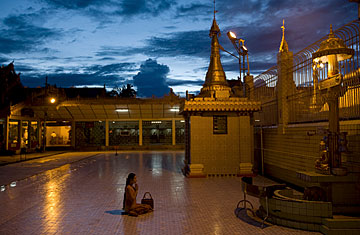
After days of pro-democracy protests brutally suppressed by the junta, Rangoon is quiet. Residents are again going about their daily life, like visiting sacred Buddhist sites
(4 of 4)
FRIDAY, SEPT. 28
The New Light of Myanmar gives its version of yesterday's events. "Groups of demonstrators in Yangon mobbed the security forces, throwing stones and sticks at them, using catapults and swords," it reads. "The security forces had to fire warning shots." The official toll is 10 dead, including Nagai. But everyone believes the real death toll is much higher. A U.N. official tells me 40 were killed and 3,000 arrested, including 1,000 monks. Another diplomat hazards "hundreds" of deaths.
The crackdown — the killings and beatings, the thousands of arrests — seems to have worked. The protests today are small and sporadic; one in the downtown area is defused by troops firing more "rubber bullets" down Anawratha Street. There are no more marches: their rallying points, the Shwedagon and Sule pagodas, are locked and guarded. A hundred or so people are jeering at soldiers on Pansodan Street. I watch the soldiers strike a youth over the head, before pushing him into a truck. "A schoolboy," remarks another onlooker angrily.
The 2007 democracy uprising feels over. Even the monsoon rains — such a feature of these once joyous protests, with the monks marching shin-deep through flooded streets — have petered out. The sun returns and a cheerless rainbow arcs across the skyline. "Peace and stability restored, traveling and marketing back to normal in Yangon," trumpets the New Light of Myanmar.
But the junta's victory could prove Pyrrhic. Buddhism matters in Burma. The regime has spent years cultivating its image as the religion's protector. That image is now shattered. The generals' assault on a revered institution might yet cause cracks in the army's ranks. "Soldiers are humans," says a Burmese analyst in Rangoon with close ties to the military. "They have families. They have monks among their relatives." And, like Burmese everywhere, they are listening to horror stories. One teenager was stripped, beaten and interrogated by troops in a windowless building, where the floor doubled as a latrine. "Some monks told the soldiers they would go to hell one day," he told AFP. "The soldiers cried, because they knew this was true."
The prospect of eternal damnation is not the army's only problem. It is crippled by low recruitment and high desertion rates. "It's under strength," says the Burmese military analyst. "Most regiments have fewer than 200 men. Nobody wants to join the army anymore." I saw many troops in Rangoon ill-equipped with rusting rifles. The soldier who killed Nagai was wearing flip-flops.
The economic misery that sparked the protests, moreover, remains unaddressed. "People have been successfully intimidated into keeping their heads down — maybe," says Shari Villarosa, chargé d'affaires at the U.S. embassy in Rangoon. "But it's still a struggle for them to survive. So there could be another eruption. I wouldn't be surprised."
If that happens, what can the world do? There is already intense international pressure, although its impact on this xenophobic regime is questionable. Over four days in Burma, U.N. special envoy Ibrahim Gambari met both Suu Kyi (twice) and junta chief Than Shwe, but his efforts look unlikely to kick-start a dialogue between the two. Similarly, China's influence over Burma — and its willingness to use it — is probably exaggerated. A Western diplomat in Rangoon says Beijing would like to see Burma make a "managed transition" — not to democracy, but to "something with a more stable base of popular support." But China's U.N. ambassador, Wang Guangya, recently characterized Burma's troubles as "basically internal."
For millions of people worldwide — from college students to America's First Lady — Burma is more than a country. It is a heartfelt cause. So far, however, it is a failed one, mired in a well-intentioned but self-defeating obsession with sanctions that barely dent the finances of the generals. Meanwhile, Burma has a grave and worsening humanitarian crisis: half of all Asia's malaria deaths occur here; a third of children under 5 years old are malnourished; most of its people live on less than a dollar a day. Yet Burma receives less humanitarian aid than almost every other poor country.
The U.S. government is calling for "meaningful dialogue" with all the democratic groups in Burma. So are the usually quiescent members of the Association of Southeast Asian Nations. Will any of this make a difference? "In 1988, Burma wasn't part of ASEAN, it wasn't in the international spotlight, and the effects of globalization weren't so obvious," says the military analyst. "Maybe I'm too optimistic, but I feel this time the generals have to address the situation in some way."
Burma is often described as an isolated country. Yet it's not the people who are isolated — witness, for example, how skillfully they used the Internet to globalize their protests — but the generals. The world's challenge is finding ways to break that isolation and convince Burma's rulers to listen to its people. Before leaving Rangoon I met a former political prisoner who was delighted to see so many young students in the recent protests. "Some were carrying fighting peacock flags, just like in '88," he said. "The message has clearly got through to the next generation." The junta's troubles aren't finished yet. Nor are Burma's irrepressible democrats.