

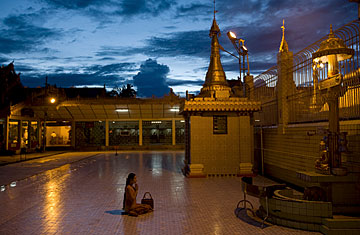
After days of pro-democracy protests brutally suppressed by the junta, Rangoon is quiet. Residents are again going about their daily life, like visiting sacred Buddhist sites
(3 of 4)
WEDNESDAY, SEPT. 26
The eastern gate of the Shwedagon is where thousands of monks usually exit to start their march into downtown Rangoon. But today the gate is locked and guarded by soldiers and riot police. They are confronted by hundreds of angry monks and students. It is a little after noon, and the battle for Shwedagon is about to begin.
There are explosions — smoke bombs, meant to shock and disorient — and the riot police charge, striking the protesters with canes. The monks and students fight back, and soon there is the unmistakable crackle of live ammunition — the soldiers are shooting above our heads. The monks dress their wounds and begin their march downtown. Trucks full of soldiers pursue them, watched from the pavement by eerily silent crowds. Near Sule Pagoda, trucks are jeered and pelted with rocks, and the soldiers again open fire over the protesters' heads. But as dusk approaches, the crowds disperse. The shops have been shuttered all afternoon, and the pavement teashops for which Rangoon is famous vanish. Nobody wants to be out on the streets after dark.
THURSDAY, SEPT. 27
During last night's curfew, troops surge into monasteries across the city, beating and arresting monks. At Ngwe Kyar Yan, a monastery famed for its leadership role in the 1988 uprising, the floors are puddled with blood and the thin dormitory walls perforated with what Burmese call "rubber bullets." They are actually ball-bearings with a thin rubber coating, shot from a 40-mm cartridge. A direct hit at close range can take out eyes, crack skulls, stop hearts.
The raids enrage the people. The lives of Burmese Buddhists are intertwined with the lives of the monks. Monks preside over marriages, chant over the dead; they shelter orphans, care for the sick; and they rely upon the people for food, medicine, clothes and shelter. "A devout Buddhist will not even step on the shadow of a monk," says a Rangoon resident. "When a monk approaches, we move aside to let him pass." And so, with soldiers and police still inside Ngwe Kyar Yan, hundreds of local people surround it. "We had no weapons and knew we couldn't compete with the military," a neighbor tells me. "Everyone just wanted to protect the monks." Eventually, with night approaching, the security forces fight their way out with live rounds, killing two people.
"You should get closer." And so I find myself in a crowd near the Sule Pagoda, facing soldiers and riot police. Only a handful of monks have escaped the junta's dragnet to join this protest. When more trucks pull up at the intersection, and the troops inside noisily cock their rifles, the crowd tenses as one. Seconds later, there are explosions — more smoke bombs — and we are running for our lives.
We run along the pavements, keeping low, chased by the sound of gunfire and more explosions. The nearest escape route is 33rd Street, narrow like so many in the downtown area, and it is a seething bottleneck of people — sitting ducks — so I run on and dart up 34th Street. Are they firing over our heads? Not all the time. Not far from where I had been standing lies the body of Japanese cameraman Kenji Nagai, shot dead by a soldier at point-blank range.
People say the troops used tear gas. They didn't, because I never feel its sting in my eyes. But there are tears, nonetheless. I meet an old man, a retired engineer, choked with emotion. I asked him if he had joined the protests. "No," he replies. "I am too old now to run from bullets." At that moment, more military trucks race past; one soldier trains his rifle on the crowds, and scowls. "Quick, we must go," says the old man. "They are going to start shooting us."
Riot police are marching north up Sule Pagoda Road, banging their truncheons against their shields. An even more menacing sight is behind: hundreds of troops, marching in formation, sealing off downtown Rangoon. Between the riot police and the troops are trucks with loudspeakers making announcements to clear the streets. For more than a week — for most of their lifetimes — Burmese have called peacefully for dialogue. This is the closest the junta gets to it: screaming at its people through loudspeakers from a truck surrounded by men with guns.
I can still hear gunfire at 5 p.m. — continuous, loud, high caliber, some of it very close, most of it caroming through the streets from the east. I phone a Burmese friend who lives in the area. He is holed up in his house with his wife and three children. "What's happening?" I ask. He replies: "They are hunting us."