

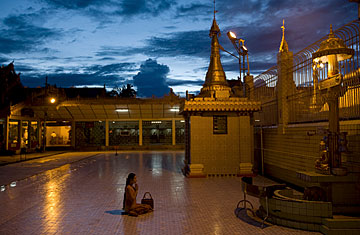
After days of pro-democracy protests brutally suppressed by the junta, Rangoon is quiet. Residents are again going about their daily life, like visiting sacred Buddhist sites
(2 of 4)
SUNDAY, SEPT. 23
They pour south from the Shwedagon, the immense golden pagoda that is Burma's most revered Buddhist monument, in an unbroken, mile-long column — barefoot, chanting, clutching pictures of Buddha, their robes drenched with the late-monsoon rains. They walk briskly — if you stick to the city's crumbling pavements it is almost impossible to keep pace with them — but when they reach Sule Pagoda they stop awhile to pray. Soon they're off again, coursing through the city streets in a solid stream of red and orange, like blood vessels giving life to an oxygen-starved body.
Their effect on Rangoon's residents is electrifying. At first, only a few applaud. Others clasp their hands together in respectful prayer, or quietly weep. One man, watching the procession without apparent emotion, abruptly folds away his umbrella so that his hands are free to applaud, and the falling rain obscures his tears. I ask another onlooker, an elderly teacher, how he feels. Overcome, he presses a clenched fist to his heart and croaks, "Happy." The monks will soon be joined by tens of thousands of Burmese, some chanting their own mantra, in English: "Democracy! Democracy!"
MONDAY, SEPT. 24
A Burmese reporter takes me to meet some monks at a pagoda in the Shwedagon's shadow, a rallying point for the daily marches. It must be under government surveillance. So, surely, is the tall figure in a white shirt and dark sarong who greets me — the poet Aung Way, another '88 stalwart, jailed three times for his political views. He presses a poem into my hand, which I nervously shove into my pocket and forget about.
Some monks chew betel-nut, which makes their mouths froth alarmingly with blood-red saliva. The oldest monk, who is 49 and from near Mandalay, is holding a Burmese translation of Francis Fukuyama's The Great Disruption. He is articulate and resolute. "We have three demands," he tells me. "Release Aung San Suu Kyi and all other political prisoners. Begin a process of national reconciliation. Lower the prices of daily commodities." China and Russia must withdraw their support for the junta, he continues, while the U.N. Security Council must discourage it from using violence.
Yet violence is what they expect. "Next they will use tear gas and water cannon," predicts another monk. "Then they will beat and arrest people. We are not afraid." A third monk, 23 years old, comes from Natmauk, the birthplace of Aung San, the father of Suu Kyi, a man whose obstinate sense of purpose won Burma's independence from Britain. "We mustn't retreat," the monk says. "If we retreat now, we fail."
In the evening Brigadier General Thura Myint Maung, Minister of Religious Affairs, appears on state television and threatens unspecified "action" against the monks. Within hours, trucks with loudspeakers are cruising Rangoon's dimly lit streets, announcing a curfew and threatening to arrest anyone who marches with the monks. The junta is making its move.
TUESDAY, SEPT. 25
So it begins. Many democracy figures are arrested overnight. The poet Aung Way is in hiding. Guiltily, I pull his poem from my pocket and read it for the first time. "We want freedom," it reads in part. "We want friendship between our army and our people." The army isn't interested. The New Light of Myanmar, the junta's barely literate newspaper, blames the violence on "hot-blooded monks" who are "jealous of national development and stability."
Still they march. The demonstrations are now so large that downtown Rangoon has a carnival atmosphere. Applause rains down from balconies overlooking the route. One monk holds aloft an upturned alms bowl, symbolizing his refusal to accept offerings from military families, a potent gesture in a devoutly Buddhist country. Students join the march, waving red flags bearing a fighting peacock — once an anticolonial emblem, but since 1962 an anti-junta one. At the rear of the column, the chants shift up a few octaves — it's a group of shaven-headed Buddhist nuns in their bubble-gum-pink robes.