

(3 of 4)
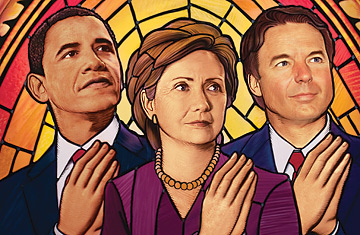
STARTING IN 2005, THE PARTY BEGAN TO TEST the holy waters. Party officials reached out to religious-news services; headquarters urged state chairs to make lists of moderate pastors and hold meetings to get acquainted. Pelosi attended the opening of megapastor Joel Osteen's new Houston church. On the Hill, lawmakers were hungry for guidance about winning back the values voter. Wallis, whose book God's Politics had set strategists humming on both sides, helped coach lawmakers on how to approach the budget as a moral document. Pelosi huddled with her advisers and emerged with blueprints for a Faith Working Group in the Democratic caucus. She put South Carolina Congressman James Clyburn, the son of a fundamentalist minister, in charge, along with help from David Price, a 10-term North Carolina Democrat with a Yale Divinity degree and a desire to remaster the Democratic message with a stronger faith-based bass line. It's hard to convince voters you care about their values, he argued, if you're not even comfortable discussing them. "I'm not looking for people to add Bible verses to speeches in an artificial way," he says, pre-empting the charge that a little rhetorical repackaging won't fool anyone. "But it's important to let fellow citizens know where you are coming from."
Price told his colleagues they had suffered for their arrogance and skepticism. Many Democrats had reflexively recoiled, for example, when Bush proposed his faith-based initiatives. "We should have said, 'Welcome to the fray, Mr. President. Where have you been? Because we have been at this a long time. So we want to work with you on that,'" Price says. "Instead Democrats took a dim view of it almost in principle."
One morning in the spring of 2005, the faith working group heard from Vanderslice, who had developed a PowerPoint presentation about her Catholic-outreach program in Michigan. Twenty-five Democratic lawmakers turned up--and they stayed to the very end. She showed them a chart revealing how much more time and money Karl Rove had invested after 2000 in building links to religious voters and how it paid off in voter response in 2004. She made the case that Democrats didn't have to sell their liberal souls; they just needed to become a plausible alternative and engage in a respectful conversation. Don't label people intolerant just because they disagree with you on some issues. Don't write anyone off. "The basic message," she says, "was that we had not tapped into this huge group of people."
At the same time, small-scale mutinies within evangelical circles provided yet more evidence that some traditional religious allegiances no longer held. The conservative evangelical Alabama state chairman of the Christian Coalition doesn't sound like a natural ally for Democrats, but Randy Brinson is as politically ecumenical as he is religiously devout. A professional gastroenterologist and amateur music buff, he was inspired during the most recent presidential campaign to mirror the Rock the Vote campaign by founding Redeem the Vote, which used Christian radio and music festivals to reach out to and register young people of faith.
Brinson's success made him a hero to social conservatives, but his approach also made him a renegade. More than a third of the young people he registered were Democrats, and that was fine with him. "We weren't tied to the Republican National Committee or have some agenda. We just wanted people to vote." Plus, he says, he was more interested in consensus than in controversy or finding the next wedge issue. "Some of them don't want a solution," he says of conservative activists, "'cause you won't have an issue to raise money over."
Brinson has spent the past few years happily talking to all sides. He met with Dean, and the men talked about moral absolutes and what it means to be a Christian, and prayed together. But not everyone was thrilled that people like Brinson were poking their heads into the big Democratic tent. National Organization for Women president Kim Gandy, a Presbyterian, found herself at a luncheon where she was scheduled to speak after Jim Wallis and before Jesse Jackson. She challenged Wallis' vision of a new army of Christian soldiers head on: "I don't want a progressive evangelical movement any more than I want the conservative one we have right now," she declared. It does not constitute hostility to religion, she suggests, to want to keep it at a distance from political activity. "I don't want my pastor telling politicians what to do," she says, "or anyone else's pastor doing that."
Defenders of abortion rights and gay marriage were concerned about the tactical and rhetorical shifts they were seeing. When Hillary Clinton called abortion "tragic" and said she dreamed of the day when the procedure would never have to be performed, the approach appealed to centrists. But it inspired pro-choice champions to argue that such rhetoric makes women feel guilty and plays into the hands of the right. Just as arguments rage within the right between fiscal and social conservatives and between libertarians and virtuecrats, the left has its own internal wars.
PARTING THE RED SEA
GOING INTO LAST FALL'S MIDTERM elections, Vanderslice decided that the party was just not going to move quickly or boldly enough, and she set up shop on her own. She formed Common Good Strategies in July 2005 and recruited Price's staffer Eric Sapp, who has degrees from Duke in policy and divinity, as a partner in October. It was the first Democratic-tilted, faith-based political-consulting firm. They acted as matchmakers between candidates and receptive clergy and helped candidates navigate the Christian media markets and develop a message that crossed party and religious lines. Overall, Vanderslice and Sapp's candidates--including Michigan's Governor Jennifer Granholm, a pro-choice Catholic, and Ohio's Ted Strickland, a former Methodist minister--did at least 10 percentage points better than the Democrats' national average among white Evangelicals and churchgoing Catholics.
But the 2006 election results, rather than providing aid and comfort to those who hoped to close the party's 30-year God gap, actually did the opposite. Democratic House candidates pulled in 67% of the secular, nonchurchgoing vote last year--7 percentage points more than in 2004. That growth spurt made it easier for skeptical factions inside the party's power structure to argue that nonreligious voters are an even more vital part of the Democratic coalition now--and that religious outreach is a waste of precious resources and time.