

(2 of 4)
The Democratic Party is rekindling its relationship with Catholics as well. For years, candidates dodged Catholics out of fear that abortion would dominate the discussion. Now Democratic leaders are pursuing alliances with the Roman Catholic Church on issues ranging from immigration to the minimum wage to Iraq. Catholic voters, Democrats realize, are the loosest swing vote in the spiritual cosmos, especially as the church has become more outspoken in its opposition to the war in Iraq.
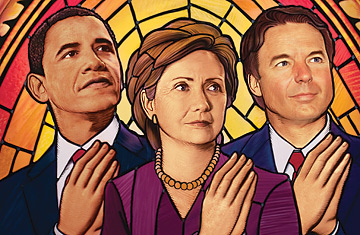
Add to these twists the fact that the leading Democrats are all married to their original spouses and all fluent in the language of faith--a shift from the era when Democrats limited their spiritual testimonies to awkward appearances at black churches shortly before Election Day. It was Obama who first signaled a shift when he spoke last year at the Sojourners/Call to Renewal gathering and challenged Democrats to make it a little harder for Republicans to paint them as godless hedonists. "If we scrub language of all religious content, we forfeit the imagery and terminology through which millions of Americans understand both their personal morality and social justice," he declared. "Secularists are wrong when they ask believers to leave their religion at the door before entering into the public square."
Last month Obama was joined by Edwards and Clinton at the Sojourners' forum on Faith, Values and Poverty, where the progressive evangelical leader Jim Wallis pressed them to show some spiritual skin. Edwards explained how he reconciled evolution, which he accepts, with creationism, which he was taught growing up as a Southern Baptist. "The hand of God today," he said, "is in every step of what happens with me and every human being that exists on this planet." Clinton shared the content of her prayer life with the audience: "You know, sometimes I say, Oh, Lord, why can't you help me lose weight?" she said to sympathetic laughter. "Sometimes, you know, it's praying for discernment, for wisdom, for strength, for courage."
Clinton has been more confiding about her faith in recent months, in part because she is in an unexpected footrace for the churchgoing vote. According to a poll for TIME by Pulsar Research, Obama is viewed as a person of strong religious faith by three times as many Republicans as Clinton is, and he reaps political benefits as a result. His approval ratings in red states match Giuliani's, and while Clinton's unfavorable ratings among conservative Protestants are at 65%, Obama's hover at 27%.
THE VALLEY OF THE SHADOW OF DEFEAT
THERE WAS A CERTAIN PURITY TO JOHN Kerry's failure in 2004: when it came to religious voters, as the saying goes, he never missed an opportunity to miss an opportunity.
Mara Vanderslice would know, since she was the person nominally in charge of shaping his religious identity. Vanderslice, who just turned 32, is a secret agent of sorts who grew up in a Unitarian Democratic household in Boulder, Colo., where she was raised to believe that Christians tended to be Republicans and vice versa. She went off to Earlham College in Indiana, an earnest Quaker school with a dry campus where students took themselves and their role in the world seriously. A semester abroad in Central America launched her on a spiritual journey, which led to her baptism by full immersion in a Potomac tributary. Helping the least, the lost and the last, however, wasn't exactly the GOP platform at the time. "I never understood," she says, "how the Gospel made people Republicans."
But soon she got a glimpse of the answer.
Vanderslice arrived in Iowa in December 2003 to work on religious outreach for Howard Dean's presidential campaign. The job was something of a contradiction in terms. Dean, who had left his Episcopal church over an argument concerning the placement of a bike path, often argued that campaigns should avoid subjects like "guns, God and gays" and boasted that "my religion doesn't inform my public policy." Vanderslice found herself working with advisers who wondered what she was doing there and a candidate who rarely mentioned religious groups except to attack them. "Those voters were a target," she recalled of Evangelicals, "not a target audience."
The reception warmed only slightly when she graduated to the Kerry campaign. "I got my first insight into how behind the Democrats were," she recalls. Not long after she joined the campaign, a handful of Catholic bishops who denounced Kerry's position on abortion publicly suggested that he should be denied Communion. Vanderslice's recommendations that it would be a good idea to return calls from Christianity Today or accept an invitation to speak at John Carroll University were all shot down. But in the final stretch of the campaign, she was dispatched to Michigan, a state whose Catholic voters had longed to meet a Democrat they could talk to. In her first week alone, 72 people walked in the door and volunteered to help. Soon she had nuns doing phone banks, talking about the religious resonances of Kerry's positions. In the end, of course, Kerry lost the race. But he did 15 percentage points better with weekly churchgoing Catholics in Michigan than he did in other states.
Stunned by the results, Democratic leaders launched polls and focus groups and strategy sessions. At the Democratic headquarters, even Dean, now chair of the Democratic National Committee (DNC), was getting into the spirit. He had seen the Democrats' share of the evangelical vote drop from 33%, when Bill Clinton ran, to 17% for Kerry. Dean's aides began asking state party chairs, Do you talk to religious press? Do you know any religious leaders, even? Ever think to organize them? The response came back, Well, no, not really. Like the national party, most local Democrats had always done their outreach to various constituencies in silos--veterans on one set of issues, African Americans on another, women on another and so forth. There was never any common language of faith to appeal to those voters. "We walked away from the single institution most Americans turned to when they try to be better than they are," admits Carl Pope, executive director of the Sierra Club. "It was a huge mistake."
THE SEEDS OF REVIVAL