

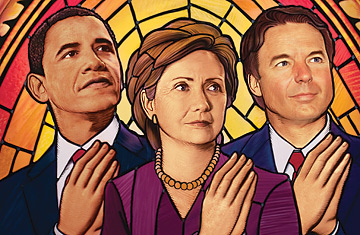
[This article consists of a two complex illustrations. Please see hardcopy of magazine.]
A president has to be a preacher of sorts, instructing, consoling, summoning citizens to sacrifice for some common good. But candidates are competitors, which means they seldom manage to talk about faith in a way that doesn't disturb people, doesn't divide them, doesn't nail campaign posters on the gates of heaven. Republicans have been charged with exploiting religious voters, Democrats with ignoring them: Hillary Clinton's voice gets tight as she recalls the mocking response she received when she first spoke in spiritual terms about the longing that people felt to invest in causes larger than self-interest. "I talked about my faith years ago and was pilloried for it," she says, and it is hard to tell if she is more impatient with the conservatives who presumed they held the patent on piety or with the liberals whose worship of diversity all but excluded the devout.
But maybe, she suggests, candidates have learned something from the holy wars of recent years. "Maybe we're getting back to where people can be who they are," she says. "If faith is an element of who you legitimately, authentically are, great. But don't make it up, don't use it, don't beat people over the head with it."
In this campaign season, if Clinton and Barack Obama and John Edwards are any measure, there will be nothing unusual in Democrats' talking about the God who guides them and the beliefs that sustain them. Clinton has hired Burns Strider, a congressional staffer (and evangelical Baptist from Mississippi) who is assembling a faith steering group from major denominations and sends out a weekly wrap-up, Faith, Family and Values. Edwards has been organizing conference calls with progressive religious leaders and is about to embark on a 12-city poverty tour. In the past month alone, Obama's campaign has run six faith forums in New Hampshire, where local clergy and laypeople discuss religious engagement in politics. "We talk about ways people of faith have gone wrong in the past, what they have done right and where they see it going in the future," says his faith-outreach adviser, Joshua DuBois. Speeches on everything from the budget to immigration to stem-cell research are carefully marinated in Scripture. "Science is a gift of God to all of us," said House Speaker Nancy Pelosi during a debate on increased embryo-research funding, "and science has taken us to a place that is biblical in its power to cure."
The Democrats are so fired up, you could call them the new Moral Majority. This time, however, the emphasis is as much on the majority as on the morality as they try to frame a message in terms of broadly shared values that don't alarm members of minority religions or secular voters. It has become an article of faith among party leaders that it was sheer strategic stupidity to cede the values debate to Republicans for so long; that most people want to reduce abortion but not criminalize it, protect the earth instead of the auto industry, raise up the least among us; and that a lot of voters care as much about the candidates' principles as about their policies. "What we're seeing," says strategist Mike McCurry, "is a Great Awakening in the Democratic Party."
The revival comes at a time when the entire religious-political landscape is changing shape. A new generation of evangelical leaders is rejecting old labels; now an alliance of religious activists that runs from the crunchy left across to the National Association of Evangelicals has called for action to address global warming, citing the biblical imperative of caring for creation. Mainline, evangelical and Roman Catholic organizations have united to push for immigration reform. The possibility that there is common ground to be colonized by those willing to look for it offers a tantalizing prospect of alliances to come, but only if Democrats can overcome concerns within their party. "One-third gets it," says a Democratic values pioneer, talking about the rank and file. "A second third understands that this can help us win. And another third is positively terrified."
EVANGELICALS IN MOTION
THE DEMOCRATS' COURTSHIP OF RELIGIOUS voters exploits a rare Republican predicament: disillusioned with Bush's stewardship and serial scandals, many religious conservatives see a field in which their preferred candidates can't win, and those who can win include, for now, a politically elastic Mormon; the twice-divorced, pro-choice, gay-friendly former New York City mayor; and a maverick who called conservative religious leaders "agents of intolerance" the last time he ran. "I think that this emerging change in mind-set, at least within significant segments of the Democratic Party, could pay tremendous dividends if the Republicans are foolish enough to nominate Rudy Giuliani," says Richard Land, the Southern Baptist Convention's political guru. While a Mitt Romney nomination might suppress evangelical turnout, he says, as long as there is a basic difference over abortion, socially conservative voters will pick the pro-life candidate. "But if you take the abortion issue off the table," Land predicts, "then a lot of these other issues get oxygen they aren't getting now, such as the environment and social justice and racial reconciliation, all of which Evangelicals care about."
The best handicapper of the religious vote is political scientist John C. Green, senior fellow at the Pew Forum on Religion and Public Life, who has studied the voting habits of the country's 55 million Evangelicals. The most conservative white Protestants, he says, are all but off-limits to the Democrats. But then there are more than 22 million voters he calls "freestyle Evangelicals," worried about not only their eternal souls but also their kids' schools, their car's fuel efficiency and the crisis in Darfur. In the past, those voters may have leaned Republican in part because the GOP has been far smarter about presenting itself as friendly to people of faith while painting the Democrats as a bunch of sneering, secular coastal élites.
But the Republican lock on Evangelicals may be breaking. The percentage of white Evangelicals who self-identify as Republicans has declined from roughly 50% in 2004 to about 44% this past February, according to Green. Now the number is closer to 40% as more Evangelicals choose to label themselves independents. "There is a loosening of the Republican coalition, particularly among people under 30," Green says, "but it is not yet a movement toward the Democrats. It is a small but real change."