

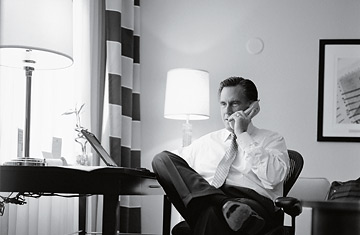
Presidential hopeful Mitt Romney in his hotel in Miami, March 9, 2007
(3 of 4)
Being Mormon made the family unusual in tony Bloomfield Hills, though Mitt doesn't remember anything that felt like ostracism at his élite prep school, Cranbrook. (Then again, he was the Governor's son.) "My faith was not a burden to me. I didn't smoke and I didn't drink, and that was about it" in distinguishing him from his classmates socially, he says. "I think it's a helpful thing for the development of the character of a young person to be different from their peers. It's a blessing to be different and stand up for that."
The closest he has ever come to a personal religious crisis, he recalls, was when he was in college and considering whether to go off on a mission, as his grandfather, father and brother had done. Mitt was deeply in love with Ann, his high school sweetheart and future wife, and couldn't bear to spend more than two years away from her. He says he also felt guilty about the draft deferment he would get for it, when other young men his age were heading for Vietnam. In the end, it was Ann--a convert to Mormonism from having been a once-a-year churchgoing Episcopalian--who persuaded him to go, saying he would always regret it if he didn't. He didn't convert many Frenchmen but found the experience was something that "concentrates the mind," he says. "My faith has been a part of my foundation throughout my life. My faith has made me a better person than I would have been."
After his return and his graduation from college, Mitt and his father didn't see eye to eye on what he should do next. George argued for law school; Mitt wanted to go to business school. So he pursued both degrees simultaneously at Harvard. Romney would immediately put that business degree to spectacularly successful use. But whereas his father had been an industrialist, staking his fortunes on what he produced, Mitt moved first into consulting and then into venture capitalism--a field in which, says his former partner and current campaign chairman Bob White, "you need to be able to quickly recognize a good opportunity. You need to be able to assess it in relatively quick, short time frames." Venture capitalists take big risks, with the hope of even bigger returns, often by dismantling a business, jettisoning what doesn't work, retooling what does and unloading the whole thing at a big profit. Romney's firm Bain Capital started in 1984 with $37 million in assets under management; by the late 1990s, it had billions. One of Romney's biggest achievements was seeing the potential for the office-supply chain Staples in the 1980s, when few could imagine a time businesses wouldn't just get their paper and pens delivered. In describing his own management style, Romney draws none-too-subtle contrasts with the current occupant of the Oval Office. Romney loves "wallowing in the data," he says, and is not comfortable making a decision unless he has heard opposing viewpoints. "I will insist on someone disagreeing," Romney adds, "and then I want to insist on data and analysis."
But by the late 1990s, he was getting restless with his lucrative business career. His 1994 Senate race against Kennedy had given him a political bug, and though he lost, 58% to 41%, he got close enough in the pre-election polls to give the liberal lion a scare. (The final outcome was Kennedy's closest race since his first election, in 1962.) Then Romney's biggest turnaround opportunity presented itself. In 1999 he was recruited to take over the scandal-ridden Salt Lake City Winter Olympics and dig it out of a nearly $400 million operating deficit by 2002. The zest with which he did it, rallying 23,000 volunteers behind him, made him a celebrity, with an added aura of grace for having pulled it off in the aftermath of 9/11.
The torch had barely been extinguished when Romney decided to take another shot at politics, again with the opportunistic instincts of a venture capitalist. He muscled aside a vulnerable G.O.P. incumbent, acting Governor Jane Swift, after promising not to run against her; then he sideswiped Democrat Shannon O'Brien. After she accused him of trying to "mask a very conservative set of belief systems," Romney called her "unbecoming," leaving the impression that he considered it a none-too-veiled attack on his religion. He won, 50% to 45%, carrying many of the Democratic areas of the state.
Critics say his four years in office produced very little. "There's two ways to look at this guy. One is that the glass is half empty. The other is that the glass is totally empty," says Stephen Crosby, a Republican who served in the Swift administration and is now dean of the graduate school of policy studies at the University of Massachusetts, Boston. Romney's ads and campaign speeches boast of engineering an economic turnaround. But Michael Widmer, president of the nonpartisan Massachusetts Taxpayers Foundation, points out that the state has lagged most others in job growth. And while Romney closed a $3 billion deficit without raising taxes, he did it in part by raising numerous fees, as well as shifting some of the burden by cutting aid to cities and municipalities.
Interestingly, the biggest accomplishment of his tenure--the state's new health-care program--is something he rarely mentions on the trail, perhaps because the program is turning out to be more expensive than advertised and perhaps because "universal health care" is a rallying cry associated more with Hillary Clinton than with any Republican politician. Though the final deal was cut by the Democratic legislature, officials in Massachusetts say it couldn't have happened if Romney had not championed the concept of universal health coverage with voters and businesses. The Governor was also the one who put on the table the idea of requiring individuals to buy health insurance if they were not covered by their employers--a move that gave Democrats the political cover they needed to put other controversial parts of the plan into place.
What rankles many in Massachusetts is that the liberal state has become the butt of many of Romney's jokes. But it did give Romney an opportunity to take the national stage on a pair of social issues that matter a lot to conservatives: stem-cell research and gay marriage. When the Massachusetts Supreme Court ruled on Nov. 18, 2003, that the state constitution mandates gay marriage, he undertook to amend the constitution to ban it. He also called for a federal constitutional amendment, getting to the right of McCain on the issue. And he went to war with the Democratic legislature over stem-cell research, though his position on that issue is not entirely consistent with that of pro-life groups. Romney--whose wife suffers from multiple sclerosis--supports the use of embryos harvested but not used for in vitro fertilization. He's not for cloning.